
Mid-Year Report
August 1, 2025 – January 31, 2026
Executive summary
About the numbers
- Accepted complaints are up 61% — from 11,909 complaints at last year’s mid-point to 19,157 this year (mid-year range: August 1, 2025, and January 31, 2026).
- 88% of concluded complaints were successfully resolved, up 3% since last year’s mid-point. Most of those resolutions were achieved within 20 days.
- Wireless continues to be the service customers complained about the most, accounting for 56% of all issues raised in complaints. The rise in wireless complaints is largely driven by customer concerns related to installation and activation fees, incorrect monthly plan charges, and roaming charges.
- Billing issues remain the top concern for customers. Concerns about being charged the wrong amount for monthly plans account for over 15% of all issues raised by customers in complaints.
- Rogers/Shaw had the highest number of accepted complaints, representing 34% of all complaints accepted by the CCTS during the reporting period. TELUS and Bell rounded out the top three, accounting for 16% and 13% of accepted complaints, respectively.
- Among the five most complained about providers, Fido had the largest increase in accepted complaints (up 156%), followed by Rogers/Shaw complaints, which are up 95%. (see Table 3)
- Five Participating Service Providers (PSPs) represent 79% of all accepted complaints: Rogers/Shaw, TELUS, Bell, Fido, and Koodo.
- There were more than twice as many CRTC Consumer Protection Code breaches during this reporting period compared to last year’s mid-point.
All comparisons are to Mid-Year Report 2024-25 unless otherwise specified.
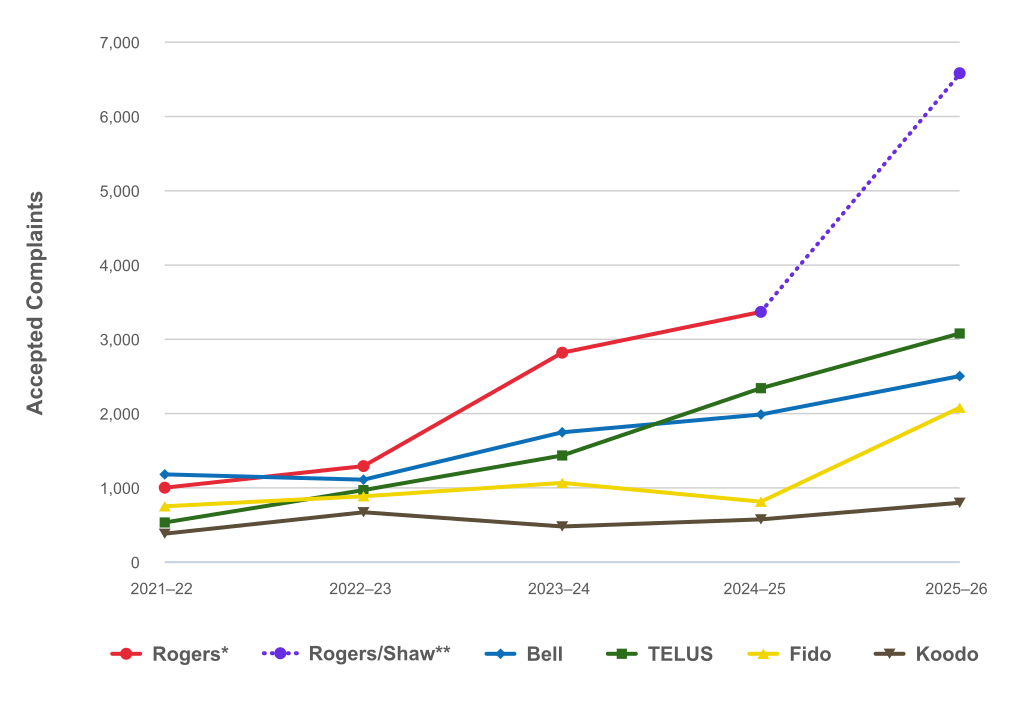
Numbers reflect accepted complaints at mid-year point (August 1 to January 31) of each reporting period.
* Reflects accepted complaints for Rogers only.
** Reflects accepted complaints for Rogers and Shaw combined.
In this Mid-Year Report, complaints about Rogers and Shaw are counted together as Rogers/Shaw, reflecting their integrated branding as “Rogers together with Shaw”. All complaints received by the CCTS since 2024-25 for Rogers/Shaw have been reported as one provider.
For historical comparison purposes, the results for 2021–22 through 2023–24 in Figure 1 and Table 1 reflect accepted complaints for Rogers only. The results for 2024–25 and 2025–26 reflect accepted complaints for Rogers and Shaw combined.
Numbers reflect accepted complaints at mid-year point (August 1 to January 31) of each reporting period.
* Reflects accepted complaints for Rogers only.
** Reflects accepted complaints for Rogers and Shaw combined.
About our activities
- Improved our complaint handling technology and process to ensure timely responses for service providers, as well as customers that rely on the CCTS for help with unresolved issues.
- Met or exceeded most of our complaint-handling performance targets. We accepted 98% of complaints within three business days to determine if they met eligibility criteria. 85% of all complaints were concluded across all stages of our complaint-handling process within 60 days.
- Celebrated the one-year anniversary since the launch of our Investigation Findings Library. Now with over 125 entries, this selection of anonymized complaint investigation summaries provides transparency into how the CCTS approaches decision-making in our complaint-handling work. In the vast majority of cases, the CCTS helps service providers and customers resolve concerns. The CCTS investigates the merit of any unresolved issues at later stages of its process.
- Announced the appointment of Josée Bidal Thibault as our new Commissioner and Chief Executive Officer, effective January 1, 2026. We also extended our gratitude to Howard Maker for 17 years of dedicated service as CCTS’ founding Commissioner.
- Published our 2024-25 Annual Report, outlining how we helped a record number of customers resolve complaints about their wireless, internet, phone, and TV services. The report details our activities and the complaints we received between August 1, 2024, and July 31, 2025.
- Continued our own public awareness efforts to inform various audiences across Canada – including community and civic partners – about who we are and what we do. We continued to refine our communications approach using social media, search engine marketing, podcasts, community/local newspapers, and radio campaigns.
- Completed our annual audit of Participating Service Providers’ (PSPs) compliance with the CCTS public awareness requirements. These requirements help ensure Canadians know about the CCTS and how to reach us when they need help. More information about our compliance monitoring and enforcement activities can be found in our upcoming Compliance Report Cards.
- Welcomed ten new PSPs between August 1, 2025, and January 31, 2026. We also terminated the participation of six PSPs. One service provider (EasyVoice) failed to implement investigation finding remedies for six customers, and their CCTS participation was subsequently terminated due to non-compliance.
Key numbers
24,375
Complaints received
19,157
Complaints accepted
16,103
Complaints concluded
88%
Complaints resolved*
August 1, 2025 to January 31, 2026
*percentage of complaints resolved as a proportion of the number of concluded complaints.
Complaint statistics

Complaints by service provider
All statistics are as at February 1, 2026 and are subject to audit. See Appendix A for complaints accepted about all service providers.
* In this Mid-Year Report, the CCTS reports complaints for Rogers/Shaw, reflecting the integrated branding of “Rogers together with Shaw.” All year-over-year data comparisons for Rogers/Shaw are based on combined data for both brands from the previous year (2024-25).
The top five most-complained-about service providers made up 79% of all accepted complaints (Rogers/Shaw, TELUS, Bell, Fido and Koodo). Rogers/Shaw had the highest number of complaints during the reporting period.
Rogers/Shaw complaints are up 95% since last year’s mid-point. 34% of all complaints accepted by the CCTS were about Rogers/Shaw. The top concern raised in Rogers/Shaw complaints continues to be incorrect charge for monthly price plans. The increase in Rogers/Shaw complaints is driven by customer concerns related to charges for installation, activation, or reactivation and not being able to cancel service. Complaints of this nature may arise when customers believe that fees for starting, restoring, or ending services were inconsistent with what they agreed to, or lacked clear information from their provider.
Fido had the largest increase in accepted complaints among the top five most-complained-about provider brands. Fido complaints are up 156% since last year’s mid-point. Key drivers of the increase in Fido’s complaints are concerns about charges for installation, activation, or reactivation, and regular price increase of monthly price plans. Complaints about price plans may arise when customers believe the base monthly cost of their service increased unexpectedly, or without clear notice from their provider.
Issues raised in complaints
The 16,103 complaints concluded in this period raised 30,928 issues. Issues are concerns that customers have raised in their complaint. In most cases, we help customers and service providers resolve these concerns. If a concern is not resolved, we review and assess the merit of any unresolved issues during the later stages of our complaint handling process.
A single complaint can contain more than one issue, so the number of issues is higher than the number of complaints. For example, a customer may submit one complaint about both the billing of their internet service and roaming charges related to their wireless service. These are reported as two issues.
The total number of issues raised in accepted complaints increased by 37% compared to last year’s mid-point.
Wireless continues to be the service customers complained about the most, representing 56% of all issues raised in complaints. Internet services represent 28% of all issues raised.
Billing issues remain the top concern for customers across all types of service. Incorrect charge for monthly price plan issues were raised 66% more often than compared to last year’s mid-point. This issue now accounts for 15.5% of all issues raised in complaints.
Disclosure issues related to contract disputes increased by 25%, led by concerns about no consent or contract conflicting with agreement.
All comparisons are to Mid-Year Report 2024-25 unless otherwise specified.

Out-of-mandate issues
Some customer complaints involve matters that fall outside our mandate and therefore cannot be accepted. When we receive complaints about issues outside our mandate, such as pricing, infrastructure, or privacy, we advise both the customer and the service provider. We also direct the customer to the appropriate organization or complaint-handling body that can better address their concern.
Table 6 outlines the number of issues raised by customers that we were unable to accept because they were outside our mandate.
Reporting on CRTC consumer protection Codes of Conduct
In this section, we present statistical reports on the four CRTC consumer protection Codes of Conduct that the CCTS administers.
Code breaches are instances where service providers have failed to follow the consumer protection rules set out by the Canadian Radio-television and Telecommunications Commission (CRTC), the industry regulator. The codes help provide key information to consumers to inform their choices about essential wireless, internet, phone, and TV services. The CCTS administers these rules in any investigations by considering whether providers have followed their code obligations to the customer.
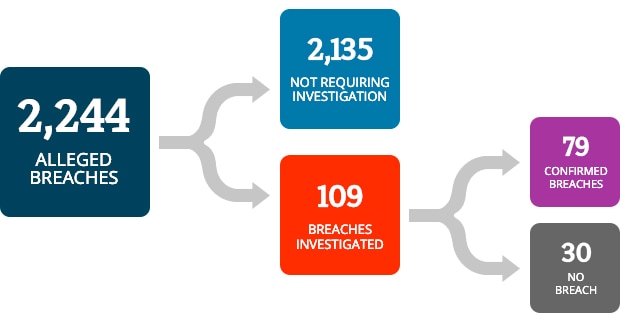
Wireless Code breaches more than doubled during the reporting period compared to last year’s mid-point, largely driven by one PSP (TELUS). Most of TELUS’ Wireless Code breaches were related to customer issues about contracts not reflecting promised discounts, and unclear communication.
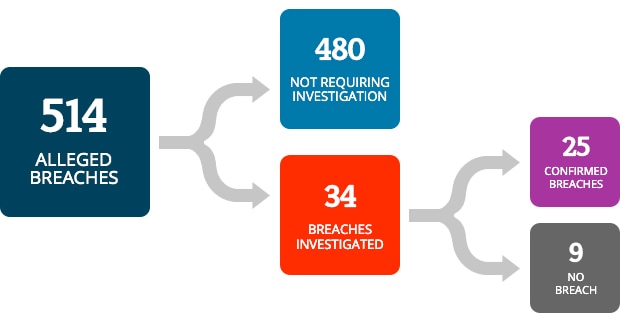
There were twenty-five total confirmed Internet Code breaches, compared with twelve reported at last year’s mid-point. Most of the confirmed Internet Code breaches were about unclear service provider communication, missing contract details, or lack of reasonable notice before a service disconnection.
CCTS’ approach to administering consumer codes
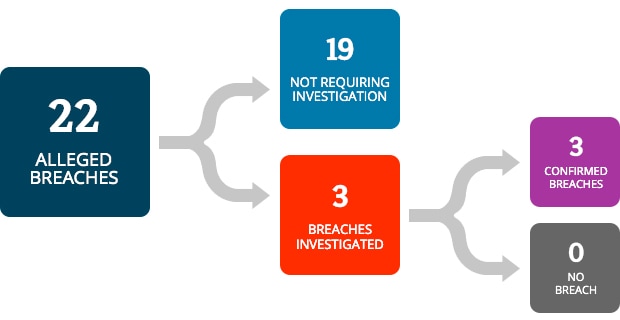
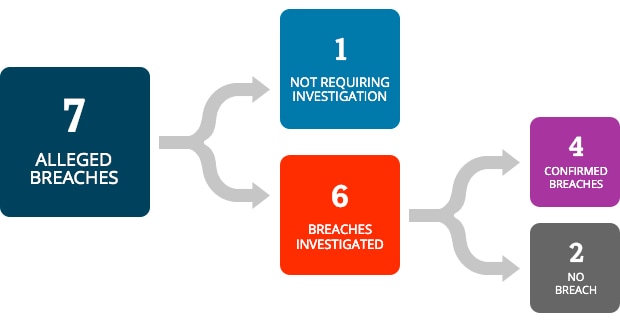
When we accept a customer complaint, we record and track all of the issues raised in the complaint. Some complaints raise questions about whether a provider has complied with a code of conduct. We call these “alleged breaches”.
The majority of the complaints we handle are resolved to the mutual satisfaction between the customer and service provider at the early stages of our process. When complaints are resolved during these initial stages, we do not have the information necessary to investigate the underlying issues, including determining if there have been any violations of a code of conduct. Therefore, these issues remain characterized as “alleged breaches” and are categorized as “not requiring investigation” in the following charts.
In the cases that we do investigate, we can determine whether there has been a violation. We categorize proven violations as “confirmed breaches”. One complaint may contain several confirmed breaches. When we investigate and determine that there has not been a violation, we categorize this as “no breach”.
Given that we investigate fewer cases to confirm if there has been a code violation, we advise caution in the use of confirmed breach numbers for analysis about systemic code compliance.
Wireless Code

| Code section | Total breaches |
|---|---|
| A.1. Plain language | 40 |
| B.1. Paper or electronic copy of the contract was not provided to the customer; contract did not include all the information listed in the Wireless Code. | 10 |
| I.2. The service provider did not give reasonable notice to the customer at least 14 calendar days or/and 24 hours before disconnection and the notice did not contain all relevant information. | 7 |
| D.1. Changes to key contract terms | 6 |
| C.1. Critical Information Summary | 4 |
| E.4. Charges for device/service not purchased | 4 |
| E.1. International roaming notification | 2 |
| E.2. Service provider did not suspend roaming data overage charges once they reached $100. | 2 |
| D.2. Changes to other contract terms and conditions | 1 |
| E.3. Service provider did not suspend data overage charges once they reached $50. | 1 |
| G.4. Trial Period | 1 |
| G.5. Cancellation date | 1 |
| Total | 79 |
1See the CRTC’s Wireless Code for full text of appropriate sections.
See Appendix B of the confirmed Wireless Code breaches by section. More information about CRTC Codes of Conduct breaches, including breaches by service provider, can be found in our Open Data files.
Internet Code
| Code section | Total breaches |
|---|---|
| G.4. Refunds for services paid in advance not provided following cancellation | 8 |
| A.1. Clear communication | 5 |
| I.2. Notice before disconnection | 4 |
| G.3. Cancellation date | 4 |
| C.1. Critical Information Summary | 1 |
| A.5. Clarity of offers | 1 |
| B.1.(i-ii) Permanent copy of the contract and related documents | 1 |
| B.5.(i)f-n Other aspects of the contract | 1 |
| Total | 25 |
2See the CRTC’s Internet Code for full text of appropriate sections.

Television Service Provider Code
| Code section | Total breaches |
|---|---|
| VII. Paper or electronic copy of the contract was not provided to the customer; contract did not include all the information listed in the Television Service Provider Code. | 2 |
| II.2 (1-2). Offers not clearly explained to consumers at point of sale. | 1 |
| Total | 3 |
Deposit and Disconnection Code
| Code section | Total breaches |
|---|---|
| 3.2. The service provider did not give reasonable notice to the customer at least 14 calendar days before disconnection or the notice did not contain all relevant information. | 2 |
| 3.3. The service provider did not give reasonable notice to the customer at least 24 hours before disconnection | 2 |
| Total | 4 |
Appendix A – Complaints by Service Provider
August 1, 2025 – January 31, 2026
This list includes service providers that received at least one complaint during the reporting period. Overall, 428 service providers and brands participated in the CCTS during this reporting period (including 10 service providers that joined during this period). Of these, 136 service providers received complaints, and no complaints were received about 292 Participating Service Providers during this period. Some of our statistical data – including accepted and concluded complaints by service provider – is publicly available in “open data” format.
Appendix B – Confirmed Wireless Code breaches by section
August 1, 2025 – January 31, 2026
In response to requests from various stakeholders, some of our statistical data – including Wireless code breaches by section – is now publicly available in “open data” format.
Glossary
Definitions
This section provides definitions for terms we use in this report. To find out more about our complaint process, visit Complaint resolution process explained on our website.
Accepted complaint
An accepted complaint is a complaint by a customer that falls within our mandate.
Alleged breach
An alleged breach happens when one or both of the following occur:
- A customer reports that a service provider has breached a particular section of a CRTC code.
- We identify a possible breach of the CRTC code when we assess the customer’s complaint.
A breach remains an alleged breach until we confirm it through investigation. There may be more than one alleged breach in a complaint. A breach happens when a service provider fails to follow the rules set out in the applicable CRTC Codes of Conduct:
Assessment
During an assessment, we review the complaint and information the customer provided to determine if we can accept the complaint.
Case Review
A customer or service provider may request a Case Review of the Investigation Findings under these two conditions:
- They believe we made an error of fact or interpretation.
and - They believe our error affected the Investigation Findings.
If it seems more likely than not that we made such an error, we conduct a Case Review. Then we issue a Case Review by confirming or amending the Investigation Findings.
Closed complaint
A closed complaint is one we have accepted but closed without resolving or investigating the issues. These are the two most common situations where we close complaints:
- The customer withdrew their complaint.
- The customer failed to communicate with us or cooperate with our process.
Code of conduct
We use four mandatory CRTC Codes of Conduct to assess the conduct of service providers:
Conciliation
A complaint moves to Conciliation under these two conditions:
- It remains unresolved after Initial Referral.
- The service provider has supplied the required information and documentation about its response to the complaint.
Conciliation is informal. We work with the customer and the service provider to explore ways to resolve the complaint without going through the time and expense of a full investigation.
Concluded complaint
A complaint is concluded when it is resolved, when we close it, or when we have issued Investigation Findings.
Confirmed breach
A confirmed breach is an alleged breach of a CRTC code that we confirmed through our investigation. A breach happens when a service provider fails to follow one of four codes of conduct issued by the CRTC:
Initial Referral
When we accept a complaint, it goes to the Initial Referral stage. At this point, we refer the complaint back to the service provider to give it another opportunity to resolve the complaint with the customer. The customer and the service provider have 20 days to resolve the issue at Initial Referral. If they don’t resolve it, it goes on to the next stage of the process.
Investigation
During the Investigation, we analyze the information the service provider and the customer supplied. We want to know if the service provider acted appropriately and whether it reasonably met its obligations to the customer as set out in its terms of service, contracts, invoices, call notes, recordings, etc.
Investigation Findings
Investigation Findings are a written report of the result of our analysis and assessment of the complaint. We issue written Investigations Findings to detail our analysis of the facts based on the information the customer and service provider gave to us. These findings explain our assessment of whether the service provider met its obligations to the customer. If they did not, the findings explain what the provider must do to fix the issue.
We have the authority to require the service provider to fix the problem by doing one or more of these actions:
- explain or apologize for the problem
- correct the problem, such as correct a billing error
- reconnect a service
- stop collections activity
- reimburse the customer for proven financial losses to a maximum of $5,000
Issue
An issue is a specific concern a customer raises in a complaint. A complaint can contain more than one issue. For example, a customer complains that their bill contains an error and that the unpaid balance resulted in a service disconnection. This is one complaint with two separate issues.
No breach
After we investigate an alleged breach, we conclude there is no breach if we find that the service provider did not violate any CRTC code provision.
Out-of-mandate
Certain complaints fall outside our mandate. These include complaints about privacy, telemarketing calls, and advertising. Since they are out-of-mandate, we cannot accept them.
Received complaint
Received complaints are complaints that customers submit. We review complaints to determine if they are within our mandate. We accept complaints that fall within our mandate.
Resolved complaint
A complaint is resolved when both the customer and the service provider agree to the solution.