Compliance with the CCTS’ Public Awareness Plan

2024 Compliance Report Cards

Canadians need to be aware of the CCTS and easily access information about it when they need help resolving disputes with their service providers. We recognize the ongoing importance of ensuring that the public knows about the services the CCTS provides and how to reach the CCTS when needed.

Participating Service Providers (PSPs) must comply with Developing Public Awareness of the CCTS (the Public Awareness Plan) and promote awareness about the CCTS to their customers.

To ensure PSP compliance, the CCTS conducts a review each year to:

  • assess compliance and identify any instances of non-compliance with the Public Awareness Plan;
  • engage with PSPs that have non-compliance issues to ensure that issues are addressed in a timely manner; and
  • take enforcement action against PSPs that do not comply.

This report card highlights our findings about PSP compliance with the Public Awareness Plan from January 1 to December 31, 2024.

Recent developments

In 2024, the telecommunications and broadcasting regulator, the Canadian Radio-television and Telecommunications Commission (CRTC) reminded providers about their responsibility to inform customers about the CCTS and stated its view that Canadians are not being made aware of the CCTS effectively.[1] The CRTC conducted polling to gauge Canadian consumers’ current level of awareness about the CCTS.[2] One key finding of the poll was that that only 2% of respondents who had an unresolved complaint after contacting their service provider were made aware of the CCTS by their service provider. Following this finding, the CRTC initiated a request for information from large service providers to better understand how providers are fulfilling their obligations to inform their customers about the CCTS.[3]

The CCTS surveys customers that have used our services after their complaint is concluded to obtain customer feedback on our process and understand how they learned of the CCTS. We publish customer survey results in each of our Annual Reports. In 2023-24, few customers reported seeing information about the CCTS from their provider’s website (10%), on their bill (20%) or being told by their provider about the CCTS (10%).[4] This feedback helps us assess the effectiveness of the PSP Public Awareness Plan.

Requirements

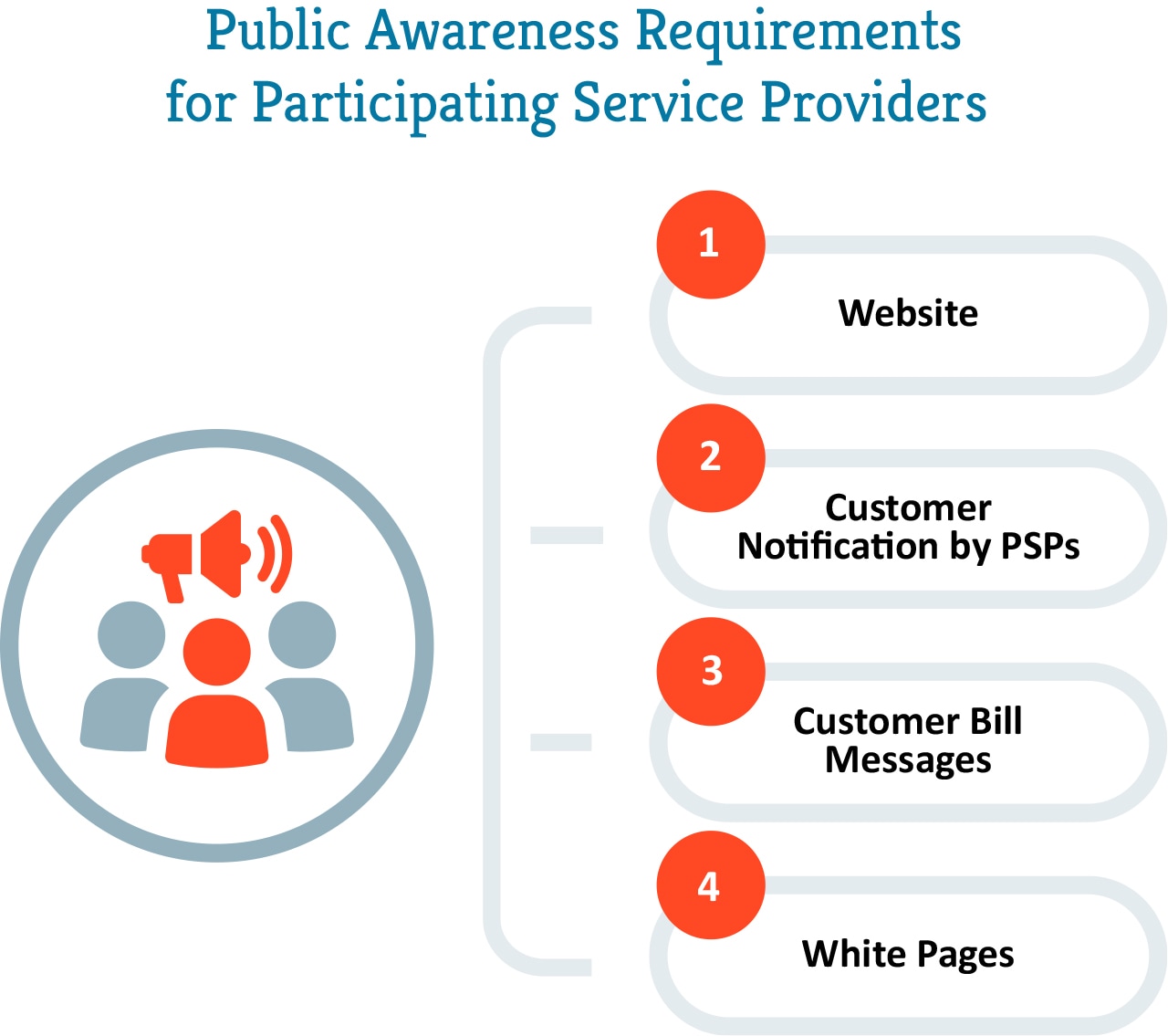
The Public Awareness Plan requires PSPs to inform their residential and small business customers about the CCTS in English and French as follows:

Our approach

Our goal is to encourage compliance through educating and engaging PSPs about the requirements of the Public Awareness Plan. This year, we sent reminders about the Public Awareness Plan to all PSPs. In the reminders, we urged PSPs to self-assess their compliance with Public Awareness Plan requirements ahead of our scheduled audits and reminded them about how to find available CCTS guidance on ensuing compliance with requirements.

The CCTS annually audits:

  • PSP websites: a review of all PSPs that are audited to ensure that all the required CCTS information is available for customers on the PSP’s website.
  • PSP documentation: a review of PSP invoices, white pages, and internal documents about the PSP’s complaint-handling process for the 25 PSPs that generated the most CCTS complaints in the previous year.

The CCTS shares its audit results for each audited PSP with the PSP. When we find issues of non-compliance, we contact the PSP, provide an explanation, and request that the PSP identify how and when it will come into compliance. Our Compliance team works with PSPs until all identified issues have been resolved, and we publicly identify any service providers who refuse to comply.

PSP websites

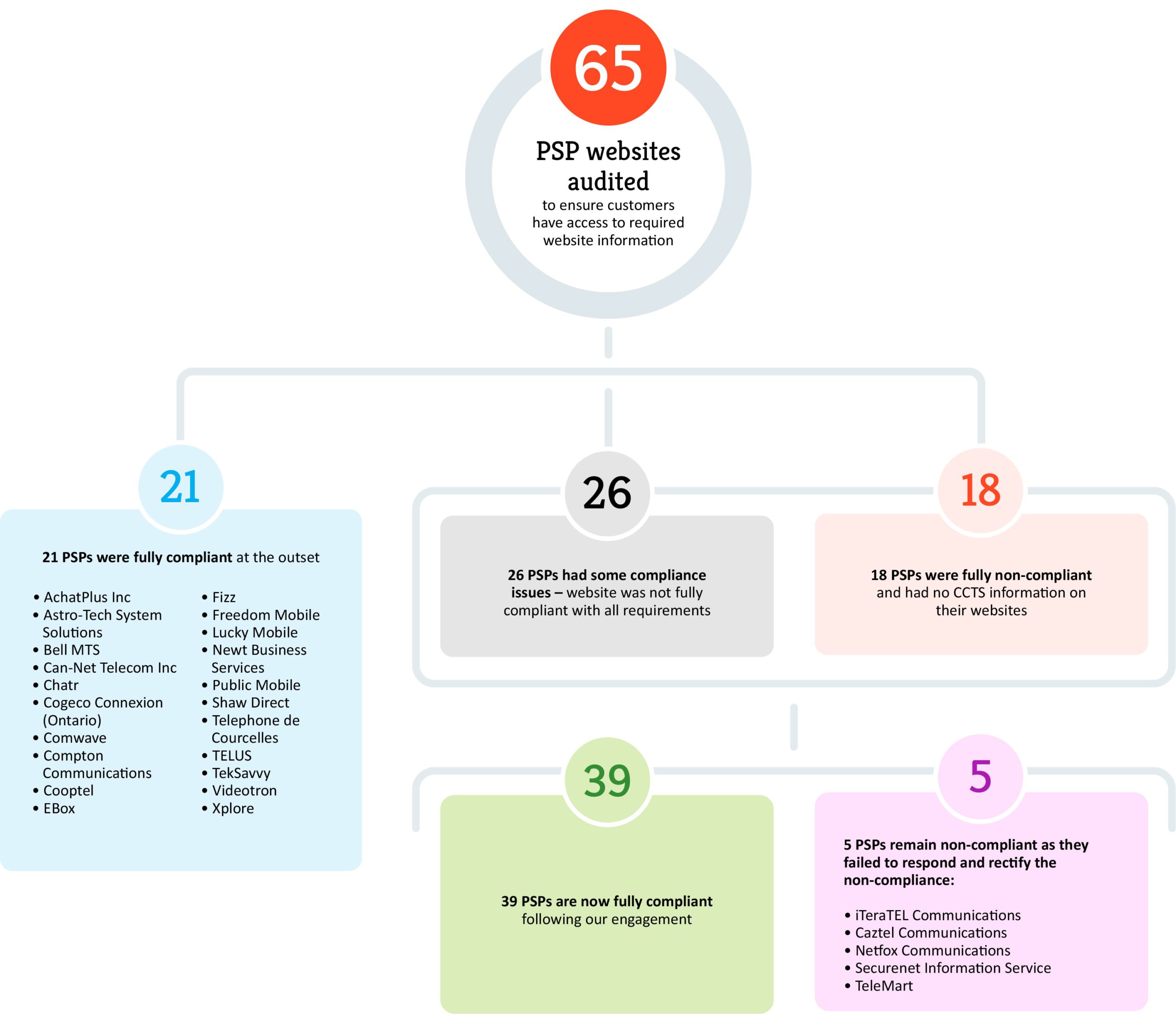
In 2024, the CCTS audited 65 PSPs[5] to ensure their customers have access to the required website information and found that 18 out of 65 audited PSPs (28%) did not have any information about the CCTS on their websites. This is consistent with the results from the last four years (28 – 32% non-compliance). The providers without information about the CCTS on their websites in 2024 were all small PSPs. We collaborated extensively with those small providers that did not have information about the CCTS on their websites, and as a result, 14 out of 18 PSPs have now added the required information to their websites.

Although most audited PSPs had some information about the CCTS on their websites prior to being audited, many of the issues we found were about how and where the CCTS information was presented. Overall audit results are in the graphic below.

Trends Observed

The CCTS highlights some of the trends seen in the past few years of our Compliance Program.

Trend 1: PSP compliance with website requirements is similar to 2023

Compliance levels were similar to what we observed in 2023. The results showed that 14 of the Top 25 PSPs were fully compliant from the onset. Of the smaller PSPs audited, only 7 out of 40 PSPs were fully compliant from the onset. 32% of PSPs were fully compliant initially, compared to 35% in 2023 and 18% in 2022.

Figure 1.1: PSPs compliance with website requirements – year over year
Figure 1.2: Rate of non-compliance with search function

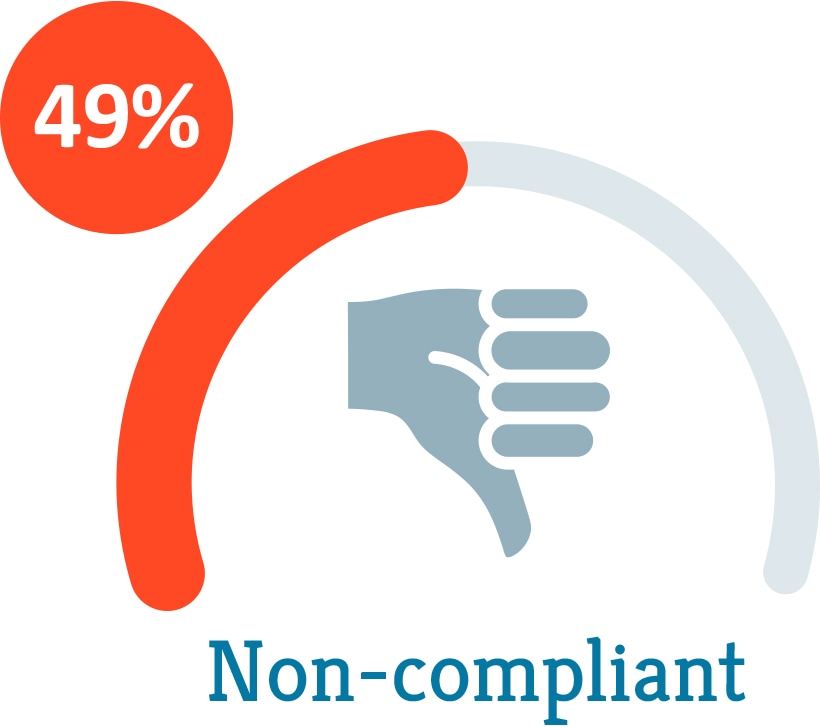
Trend 2: Almost half of PSP websites did not return search results for CCTS

In 2024, the websites of 21 of the 65 PSPs we audited had a search function. The search function on a PSP website is a crucial tool customers use to find information. PSPs must ensure that using the search function on their websites results in providing the required CCTS information to customers on residential, small business, French, and English websites. If search results do not display CCTS information on all of a PSP’s websites, the CCTS considers the PSP non-compliant. We found that 9 of the 21 PSP websites (43%) that had a search function did not return CCTS information when searching for all keywords related to ‘‘CCTS’’ and “complaints.”

Although audited PSPs have become more compliant with the search requirement in the last few years, this remains an important area of focus for our compliance efforts going forward.

The CCTS reminds PSPs about the search function requirement each year in our Compliance Monitoring Report. This year, we notified all PSPs that they should check their websites to ensure compliance and that we would publicly name those PSPs which were repeatedly non-compliant. Despite this messaging, we continue to see significant numbers of PSPs not complying with the search function requirement. However, we note that all providers the CCTS had previously identified as repeatedly non-compliant with this requirement were compliant this year.

PSPs can ensure compliance with the search function requirement by implementing an internal control process for website updates. We continue to urge all PSPs to implement internal processes and regular checks to ensure that website updates do not change the CCTS-related results that must be returned by the search function.

Trend 3: Almost half of the PSP complaint websites weren’t easy to find or clearly labelled

Service providers are required to have information about the CCTS on their websites that is easy to find and clearly labeled.

Forty-seven of the 65 PSPs we audited had websites that contained CCTS information when audited. The CCTS information on nearly half of these websites (23) was either not easy to find or not clearly labelled. Although both small service providers and some of the 25 PSPs that generated the most complaints were non-compliant most of the issues were with small provider websites (18 out of 23). Although these providers had CCTS information somewhere on their websites, the information was not located where customers would likely be able to find it easily, such as in the fine print of a Privacy Policy or Terms of Service. After the CCTS notified those providers, 22 of 23 PSPs updated their website so that customers could easily find information about the CCTS.[6]

Over the years, we’ve provided guidance to all PSPs, including examples of how to clearly label the complaint page and make it easy for customers to find information about the CCTS. We continue to encourage all PSPs to carefully review the CCTS’ guidance and check that their websites adhere to those guidelines.

Top 25 PSPs documentation

In 2024, the CCTS audited the 25 PSPs that generated the most complaints in the previous year to determine whether they complied with the documentation requirements of the Public Awareness Plan, which includes invoices, white pages and the internal complaint-handling process.

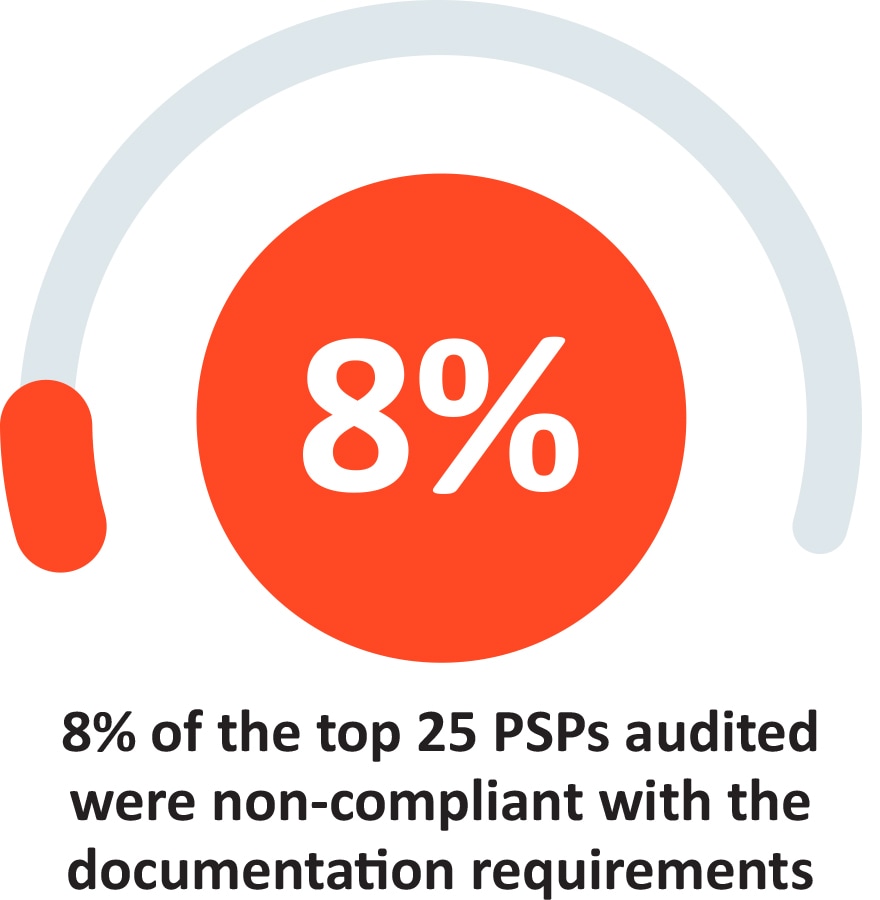
Only two of these PSPs (8%) were non-compliant with the documentation requirements:

  • One PSP could not demonstrate it had a process in place to notify its customers about the CCTS in its complaint-handling process.
  • One PSP’s invoices did not contain information about the CCTS.

The CCTS worked with both providers, and they are now compliant with the requirements of the Public Awareness Plan.

Most providers (92%) were compliant with the documentation requirements. As noted above, the CRTC’s public opinion poll found that only 2% of respondents who had an unresolved complaint were made aware of the CCTS by their service provider.[7] The CCTS’ 2023-24 customer survey results showed that only 10% of customers said that their service provider told them about the CCTS during their efforts to resolve the problem.[8] In light of this finding, the CRTC has asked providers for more information to understand why customers are not being informed about the CCTS.[9]

Conclusion

Ensuring PSPs are compliant with the CCTS’ public awareness requirements is fundamental for customers to easily find out how they can get help with unresolved telecommunications and television issues. The CCTS has annually checked PSP compliance with this requirement and will continue to engage with more PSPs to ensure they fulfill their responsibilities to promote awareness of the CCTS.

Appendix: Developing Public Awareness of the CCTS

Footnotes

  1. Statement by the CRTC’s Vice-President of Consumer, Analytics and Strategy, Scott Hutton, on recent actions to protect Canadians, 5 November 2024, https://www.canada.ca/en/radio-television-telecommunications/news/2024/11/statement-by-the-crtcs-vice-president-of-consumer-analytics-and-strategy-scott-hutton-on-recent-actions-to-protect-canadians.html.
  2. Public Opinion Research Report: “Understanding consumer awareness and satisfaction with the Commission for Complaints for Telecom-television Services (CCTS).” April, 2024. See “E. Key Findings” section: https://epe.bac-lac.gc.ca/100/200/301/pwgsc-tpsgc/por-ef/crtc/2024/080-23-e/080-23-report.html#a1.5.
  3. Broadcasting and Telecom – Secretary General Letter – ref CR104 – Reminder to Service Providers to make customers aware of the CCTS, November 5, 2024, https://crtc.gc.ca/eng/archive/2024/lb241105.htm?_ga=2.91287896.339985199.1736779617-1724186827.1713371788.
  4. CCTS 2023-24 Annual Report, “Working with customers: Listening to customers – What customers said about service provider public awareness activities” https://pub.ccts-cprst.ca/2023-2024-annual-report/working-with-customers/.
  5. There were two rounds of Public Awareness Plan audits in January 2024 and September 2024.

    • The audit conducted in January 2024 consisted of 19 randomly selected PSPs that CCTS had not previously audited and 2 PSPs previously identified as non-compliant.
    • In September 2024, we audited 44 PSPs which included the 25 PSPs that generated the most CCTS complaints in the previous year, as listed in the 2022-2023 Annual Report, 18 randomly selected PSPs (previously unaudited), and 1 PSP previously identified as non-compliant. This category ensures that all PSPs, regardless of their size and compliance status, can be reviewed from time to time to determine their compliance with the Public Awareness Plan requirements. Including this year, the CCTS has audited the websites of 249 PSP brands since 2018.

  6. iTeraTEL Communications Inc. did not update its website.
  7. Public Opinion Research Report: “Understanding consumer awareness and satisfaction with the Commission for Complaints for Telecom-television Services (CCTS).” April 2024. See “E. Key Findings” section: https://epe.bac-lac.gc.ca/100/200/301/pwgsc-tpsgc/por-ef/crtc/2024/080-23-e/080-23-report.html#a1.5.
  8. CCTS 2023-24 Annual Report, “Working with customers: Listening to customers – What customers said about service provider public awareness activities” https://pub.ccts-cprst.ca/2023-2024-annual-report/working-with-customers/.
  9. Broadcasting and Telecom – Secretary General Letter – ref CR104 – Reminder to Service Providers to make customers aware of the CCTS, November 5, 2024. https://crtc.gc.ca/eng/archive/2024/lb241105.htm?_ga=2.91287896.339985199.1736779617-1724186827.1713371788.