Our reports highlight the issues that customers encounter and have difficulty resolving with their service providers. By tracking and analyzing customer complaints, we identify recurring problems and broader trends across the telecom and television sectors. Reporting on issues at the service provider level not only gives consumers a clearer picture of their experiences but also helps inform providers about opportunities to better meet customer needs and to improve the customer experience.
This section of the Annual Report looks at the providers and brands that participate in the CCTS. It highlights changes among national provider groups and shows issue trends for the 10 most-complained-about brands.
The CRTC requires all wireless phone, internet, and licensed TV service providers in Canada to participate in the CCTS, so customers have recourse for complaints they cannot solve with their provider. If a service provider is not already a participant of the CCTS when one of their customers submits a complaint to us, they must join. A service provider that has joined the CCTS and agrees to follow our participation requirements is called a Participating Service Provider (PSP).
National PSP groups complaint analysis: five-year review
We track complaint share across national service provider groups. These groups represent the largest telecom and TV providers. They offer wireless service nationally to consumers as well as internet, phone, and TV service to large regions of Canada. These providers offer services to customers through various brands, subsidiaries, and affiliates. The national PSP group analysis aggregates complaints for all brands or companies that are commonly owned.
Table 9.1: National PSP groups and their brands
National PSP Group
Brands
Bell group
Bell Canada, Bell Aliant, Bell MTS, Virgin Plus, Lucky Mobile, Distributel, Acanac, Navigata, EBOX, Primus, Dryden Municipal Telephone System (DMTS), Kenora Municipal Telephone System (KMTS), PC Mobile (prepaid), Solo Mobile, Vox, Bell Satellite TV, Axia FibreNet, Télébec, Cablevision du Nord de Québec, Groupe Maskatel Québec S.E.C., NorthernTel, Ontera, Northwestel, 10-10-580, 450Tel, Telecommunications Xittel, Téléphone de St-Victor, Téléphone de St-Éphrem, Telephone Upton, ThinkTel, Unlimitel, Wintel, Yak, B2B2C, No Name Mobile, Oricom Internet
Note 1: In 2022–23, there was a significant amount of industry consolidation. Most notably, the Shaw and Shaw Direct brands were added to the Rogers group; Distributel, Acanac, Primus, and EBOX were added to the Bell group; and Start.ca and Altima Telecom were added to the TELUS group. Prior to 2022–23, these brands’ complaints were counted with “All other PSPs” separate from the national PSP groups.
Note 2: In 2023-24, we added the Videotron group to the national PSP groups. This is because it acquired Freedom Mobile which offers wireless services nationally.
Figure 9.1: Accepted complaints trend over four national PSP groups
Figure 9.2: Proportion of accepted complaints for the four national PSP groups
This year, total accepted complaints rose by 17% compared to last year. This increase is consistent with the upward trend seen across the four national PSP groups (Rogers, TELUS, Bell, and Videotron groups).
Together, the four national PSP groups account for 95% of all accepted complaints this year, a 2% increase compared to last year.
The Rogers group accounts for 38% of accepted complaints, which is the largest share of all national groups. The Rogers group saw an increase in accepted complaints of 15% this year.
Of the four national PSP groups, the TELUS group saw the largest increase in accepted complaints, up 38% since last year. This represents a sharp increase compared to the overall increase of 17%.
The TELUS brand was the largest driver within the TELUS group, with an increase of 78% more complaints accepted year over year. The TELUS group accounts for 27% of all accepted complaints, up from 23% last year.
The Bell group accounts for 23% of all accepted complaints, down 1% from the previous year. While its share of complaints declined, the Bell group saw an increase in complaints of 14% compared to last year.
Complaints about the Videotron group account for 7% of all accepted complaints, representing a 1% drop from last year’s report. We accepted 8% more complaints about the Videotron group this year, compared to a 17% increase overall.
Snapshot of participating service provider complaints for 2024–25
The CCTS tracks and reports on complaints by PSP brands. In 2024–25, the CCTS could accept complaints from customers of 427 brands operated by 305 participating service providers. It may not be obvious to consumers that different brands have common owners. For example, the four national PSP groups discussed in the above section collectively offer telecom and TV services via 71 brands.
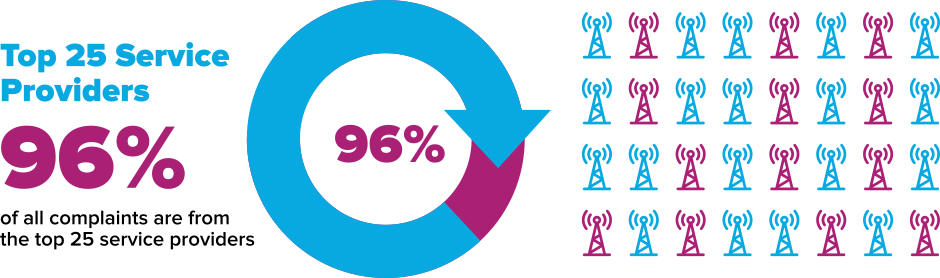
Together, the 25 brands with the highest number of accepted complaints (referred to here as the “Top 25”) account for 96% of all accepted complaints in 2024–25.
Brands that participate in the CCTS: 427 operated by 305 service providers
New Participating Service Providers in 2024–25: 14 service providers
Share of complaints by Top 25 brands: 96% of accepted complaints
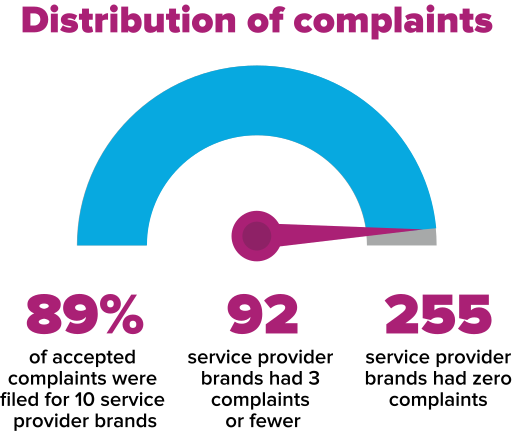
Share of complaints by Top 10 brands: 89% of accepted complaints
Three or fewer complaints: 92 service provider brands
Zero complaints: 255 service provider brands
Top 25 Participating Service Providers
Together, the Top 25 PSP brands account for 96% (21,210) of all accepted complaints in 2024–25, unchanged year over year. The remaining 4% (884) of complaints accepted were filed about 151 different service providers.
Of note, in this Annual Report, the CCTS has combined complaint data for the Rogers and Shaw brands into a single brand, referred to as “Rogers/Shaw.” All year-over-year data comparisons for Rogers/Shaw are based on combined data for both brands from the previous year. After a company is acquired, its branding can change. This can involve no rebranding (two separate brands), a period of gradual integration of the acquired brand, or the full absorption of an acquired brand into the parent company.
The Rogers acquisition of Shaw officially closed in April 2023 and was the largest telecom acquisition in Canadian history. Following the closure, the Shaw brand was evolved to “Rogers Together With Shaw.” In 2024–25, services offered on Shaw’s website were Rogers-branded services, and in June 2025, the Shaw website was retired, redirecting all products, support, and services to Rogers. For clarity in this report, the CCTS will report data about Rogers and Shaw as “Rogers/Shaw.”
Top 3
The three brands with the highest volume of complaints account for 65% of all complaints accepted by the CCTS in 2024–25. Rogers/Shaw, TELUS, and Bell remain the top three service provider brands based on accepted complaint volume. Rogers/Shaw was the brand with the highest portion of complaints, followed by TELUS and Bell. Notably, TELUS experienced a significant 78% increase in complaints, while Rogers/Shaw and Bell saw increases on par with the 17% increase in complaints across all providers.
Top 10
The 10 brands with the highest volume of complaints account for 89% of all accepted complaints this year. All the service providers in last year’s top 10 stayed on the list, except for Chatr, which moved into the top 10 after a significant 226% increase in complaints.
Fido, Virgin Plus, Videotron (for the second year in a row), and Public Mobile had fewer complaints year over year.
Top 25
The 25 brands with the highest number of accepted complaints together account for 96% of all accepted complaints. A few brands (Fongo Home Phone, EBOX, and VMedia) entered the Top 25 list this year as a result of significant year-over-year increases in accepted complaints. Below is an overview of the 25 brands with the highest number of accepted complaints. The data reflects individual brands, not their ownership groups.
Table 9.2: Top 25 PSP brands by complaints accepted
wdt_ID
Service provider
Accepted complaints
Percentage of all complaints
YoY % change of complaints accepted
Concluded complaints*
Resolution rate†
Escalation rate‡
1
Rogers/Shaw
6,485
27.4%
16.6
5,832
87.9%
18.3%
2
TELUS
4,904
20.7%
77.9
4,471
90.3%
15.0%
3
Bell
3,966
16.8%
15.6
3,819
82.6%
29.2%
4
Fido
1,877
7.9%
-7.5
1,469
88.4%
17.1%
5
Koodo
1,126
4.8%
16.7
1,071
88.4%
16.3%
6
Freedom Mobile
940
4.0%
6.2
928
92.3%
9.9%
7
Virgin Plus
831
3.5%
-2.2
836
84.2%
31.2%
8
Vidéotron
394
1.7%
-6.6
398
88.4%
11.8%
9
Public Mobile
312
1.3%
-60.7
558
58.2%
49.8%
10
Chatr
280
1.2%
225.6
238
83.2%
26.9%
NOTE: In charts throughout this report, year-over-year increases are shown in red, and year-over-year decreases are shown in green.
* The number of concluded complaints may be higher or lower than the number of accepted complaints in a given year. This occurs because complaints accepted in one reporting year may be concluded in the following year.
† The resolution rate is the percentage of all resolved complaints vs. all concluded complaints (86.1% overall).
‡ The escalation rate is the percentage of all complaints that move to later stages of the CCTS’ process vs. all concluded complaints (21.5% overall).
NOTE: Where a complaint remains unresolved after the Initial Referral period, the complaint escalates to Conciliation or Investigation.
Figure 9.3: Top 10 PSP brands by complaints accepted
Figure 9.4: Top 10 PSP brands by resolution rate
The resolution rate is the percentage of all resolved complaints vs. all concluded complaints (86.1% overall).
Rogers/Shaw
WirelessInternetPhoneTV
Insights
This year, the CCTS combined Rogers and Shaw brand data into a single brand called Rogers/Shaw, reflecting the integrated branding of “Rogers together with Shaw.” All year-over-year data comparisons for Rogers/Shaw are based on combined data for both brands from the previous year.
This year, we accepted 17% more complaints about Rogers/Shaw, consistent with the overall increase in complaints across all providers. This marks the third consecutive year of rising complaint volumes for Rogers/Shaw. This year, Rogers/Shaw accounts for 27% of all accepted complaints, down from 28% last year.
Rogers/Shaw customers raised the following issues more often this year:
Regular price increase of monthly price plan: 76% increase
Changes to the contract: 69% increase
Breach of contract: 116% increase
Early termination fees: 24% increase
Issues withrental equipment charges: from 19 issues last year to 519 issues this year, now accounting for 4% of all Rogers/Shaw issues, up from 0.2% last year. Most of these issues were due to customers raising concerns that their TV contractual arrangement provided price certainty and that the price increases to set-top-box equipment fees were not permitted.
Top-up issues: 2% of all Rogers/Shaw issues, up from 0% last year. The increase in top-up issues was about the loss of unused top-ups due to the retirement of Rogers/Shaw’s prepaid wireless services, and migration of these customers’ prepaid services to the Chatr brand, which is owned by the Rogers group. These issues are unique to prepaid wireless plans.
Television: This year, we observed a 47% increase in Rogers/Shaw TV service issues. This increase contributed significantly to overall industry increases to TV billing issues such as rental equipment fee, and increases to TV contract dispute issues such as breach of contract and change of contract. This was largely due to Rogers/Shaw increasing customer TV set-top-box rental fees. In total, the CCTS accepted 721 complaints from Rogers/Shaw customers about increases to their TV set-top-box rental fees. Customers raised concerns that their contractual arrangement provided price certainty and that the price increases to set-top-box equipment fees were not permitted. Nearly all complaints were resolved to the mutual satisfaction of the provider and the customer.
This year, we accepted 78% more complaints about TELUS Communications Inc. (TELUS) than last year. This is a significant increase compared to the 17% increase across all service providers. This marks the fifth year in a row that TELUS saw an increase in CCTS complaint volumes.
TELUS accounts for 21% of all complaints, up from 14% last year. This is the fourth year in a row that TELUS’ share of complaints has increased.
TELUS customers raised the following issues more often than last year:
Incorrect charge for monthly price plan: the top issue raised by TELUS customers, with a 70% increase
Disclosure issues: 42% increase
Credit or refund not received: 74% increase
Regular price increase of monthly price plan: 195% increase
Breach of contract: 299% increase
Wireless: Wireless issues represent 49% of all TELUS issues, up 2% from last year. TELUS customers raised 84% more wireless issues than last year. The increase in wireless issues across all service providers was 9%.
Internet: Internet issues for TELUS increased by 71% this year, compared to a 7% increase in internet issues across all service providers. Internet issues account for 29% of all TELUS issues.
Television: TV issues account for 13% of all TELUS issues. TELUS TV customers raised 97% more issues than last year, compared to a 44% increase in TV issues across all service providers.
We accepted 16% more complaints about Bell Canada (Bell) this year, marking the third consecutive year of growth in accepted complaints.
Bell accounts for 17% of all accepted complaints, down slightly by 0.2% year over year.
Bell’s customers raised the following issues more often than last year:
Breach of contract issues: 136% increase
Credit or refund not received: 29% increase
Wireless: Bell customers raised 11% more wireless issues than last year. Wireless issues account for almost half (45%) of all issues raised by Bell customers.
Internet: Bell customers raised issues about internet services 19% more this year. This increase in internet issues by Bell customers is disproportionate to the 7% year-over-year internet issue increase across all providers. Internet issues account for 29% of all Bell issues.
Television: TV issues increased 20% year over year for Bell, compared to a 44% increase in TV issues across all providers. TV issues account for 14% of all Bell issues.
Complaints about Fido decreased by 8% year over year.
Fido accounts for 8% of all accepted complaints, down from 10% last year and 12% in 2022–23.
Wireless: Fido’s wireless issues decreased by 29% year over year. Wireless issues continue to account for the majority of issues raised by Fido customers (93.5%).
Fido wireless customers reported over 110 top-up issues, representing 6% of all of Fido’s issues this year. The increase in top-up issues was about the loss of unused top-ups due to the Fido brand’s retirement of its prepaid wireless services and migration of these customers’ prepaid services to the Chatr brand, which is owned by the Rogers group.
Internet: Fido customers raised fewer internet issues this year, with a 61% decrease in internet issues. Issues about internet services account for 6.5% of Fido’s total issues.
Koodo complaints increased by 17%, which is consistent with the overall 17% increase across all service providers. Koodo accounts for 5% of all accepted complaints, the same as last year.
Overall, issues raised by Koodo customers increased by 16%, while issues across all service providers increased by 12%.
Last year, 99% of Koodo’s issues were related to wireless services. This year, distribution shifted slightly, with wireless representing 94% of Koodo’s issues and internet services accounting for 6% of Koodo’s issues.
Koodo customers raised the following issues more often than last year:
Regular price increase of monthly price plan: 80% increase
Chargeable messages: 75% increase
Third-party credit reporting: 53% increase
Incorrect charge for monthly price plan: 17% increase
Complaints accepted about Freedom Mobile increased by 6%, compared to the 17% increase across all service providers.
Freedom Mobile accounts for 4% of all accepted complaints, the same as last year.
The number of issues raised by Freedom Mobile customers increased by 12% year over year.
Wireless: Last year, 98% of issues raised about Freedom Mobile were related to wireless services. This year, the proportion of wireless issues dropped to 92%, as 8% of issues were related to its internet services.
Freedom Mobile customers raised breach of contract issues 64% more often this year.
Complaints about Virgin Plus decreased 2% from last year. Virgin Plus accounts for 4% of all accepted complaints, unchanged from last year’s report.
Wireless: Wireless issues make up 80% of all Virgin Plus issues. Overall, Virgin Plus’ total issues about its wireless services declined by 7% compared to last year.
Internet: Virgin Plus’ internet issues increased by 22%, compared to a 7% increase across all service providers. Internet issues account for 17% of all issues raised by Virgin Plus customers, up from 14% last year.
Television: Issues related to Virgin Plus’ TV services increased by 163% this year. Overall, TV issues across all brands increased by 44%. TV issues account for 3% of all Virgin Plus issues.
Code breaches: Virgin Plus had no CRTC code breaches this year. This declined for the second year in a row, down from five last year and 14 the year before.
Statistics
831 accepted complaints
-2.2% change in accepted complaints
3.5% of all accepted complaints
704 resolved complaints
537 resolved at initial referral
167 resolved at conciliation or investigation
84.2% resolution rate
(Global: 86.1%)
Top 3 issues across all service types
13% incorrect charge for monthly price plan
11% disclosure issues
9% credit or refund not received
0 Code breaches
0 Wireless Code breaches
0 Internet Code breaches
0 TVSP Code breaches
Videotron
WirelessInternetPhoneTV
Insights
While we saw a 17% increase in complaints across all service providers, complaints about Videotron decreased by 7%, after a 14% decrease the year before. Complaints about Videotron account for 2% of all accepted complaints, consistent with last year’s report.
Issues raised in complaints about Videotron services decreased by 6%, while issues across all service providers increased by 12%.
Internet: Internet services account for 36% of Videotron’s issues. Videotron customers reported internet issues 12% less often than last year. The number of internet issues increased 7% across all service providers.
Wireless: Wireless services account for 33% of all issues raised by Videotron customers. Videotron’s wireless issues increased by 9%.
Television: This year, we saw a 44% increase in TV issues across all service providers. However, Videotron’s TV issues decreased by 15%. TV services account for 21% of all Videotron issues, down from 23% last year.
Code breaches: Videotron had no CRTC code breaches this year, down from one last year.
Statistics
394 accepted complaints
-6.6% change in accepted complaints
1.7% of all accepted complaints
352 resolved complaints
333 resolved at initial referral
19 resolved at conciliation or investigation
88.4% resolution rate
(Global: 86.1%)
Top 3 issues across all service types
14% incorrect charge for monthly price plan
13% disclosure issues
8% quality of service
0 Code breaches
0 Wireless Code breaches
0 Internet Code breaches
0 TVSP Code breaches
0 D&D Code breaches
Public Mobile (TELUS group)
Wireless
Insights
Last year, we reported a significant spike in complaints about Public Mobile, which was largely driven by the retirement of its legacy rewards program. This year, Public Mobile complaints decreased by 61% year over year.
This year, Public Mobile accounts for 1% of all accepted complaints, down from 4% last year.
Public Mobile customers raised the following issues more often than last year:
Incorrect charge for monthly price plan: 47% increase
Changes to the contract: 7% increase
Intermittent quality of service: 17% increase
Wireless: Public Mobile’s wireless customers raised 6.5% more issues than last year, compared to an increase of 9% for wireless issues across all service providers.
Code breaches: Public Mobile had no CRTC code breaches this year.
Statistics
312 accepted complaints
-60.7% change in accepted complaints
1.3% of all accepted complaints
325 resolved complaints
258 resolved at initial referral
67 resolved at conciliation or investigation
58.2% resolution rate
(Global: 86.1%)
Top 3 issues across all service types
27% changes to the contract
25% credit or refund not received
11% quality of service
0 Code breaches
0 Wireless Code breaches
Chatr (Rogers group)
Wireless
Insights
Though they represent a small share of all CCTS complaints, complaints about Chatr increased significantly from 86 accepted complaints last year to 280 this year. Chatr accounts for 1.2% of all accepted complaints, up from 0.4% last year.
Wireless: There were 357 issues raised about wireless services, up from 126 last year.
Service delivery issues made up more than half (56%) of Chatr issues and increased significantly this year.
Code breaches: Chatr had no CRTC code breaches this year.
Statistics
280 accepted complaints
+225.6% change in accepted complaints
1.2% of all accepted complaints
198 resolved complaints
161 resolved at initial referral
37 resolved at conciliation or investigation
83.2% resolution rate
(Global: 86.1%)
Top 3 issues across all service types
16% quality of service
11% complete loss of service issues
7% unable to port
0 Code breaches
0 Wireless Code breaches
Monitoring service provider compliance
The Canadian Radio-television and Telecommunications Commission (CRTC) requires all providers of retail telecom services and licensed TV service providers in Canada to participate in the CCTS. This requirement ensures that all consumers in Canada can benefit from our free and effective services no matter which service provider they choose to do business with.
We regularly update information about service provider non-compliance on a dedicated webpage. To help consumers make informed choices when choosing service providers, we publish the names of providers that have been referred to the CRTC for failure to join the CCTS when required or that were expelled for not complying with their obligations. When a service provider is expelled, we refer the matter to the CRTC for enforcement action, who can require the provider to remedy its non-compliance and rejoin the CCTS.
We also publish annual compliance reports: in June 2025, we published the 2024 Compliance Report Cards. These identify service providers and their compliance with CCTS participation requirements.
There are two categories of service provider requirements:
CCTS requirements that a service provider agrees to when it becomes a Participating Service Provider (PSP)
Compliance with the requirement to join the CCTS
At the end of the 2024-25 fiscal year, we had 305 providers operating 427 brands. Some providers, mainly smaller ones and those that are new to the industry, have not yet joined. Any service provider not yet enrolled must join when one of their customers files a complaint with us. Sometimes service providers choose to sign up with us on their own.
We do everything in our power to help service providers join the CCTS, and we are generally successful. Between August 1, 2024, and July 31, 2025, we enrolled 14 new service providers. This took an average of 55 days from when we contacted them to when they enrolled.
Some providers refuse to join. If we cannot persuade them to follow this CRTC requirement, we refer the matter to the CRTC for further action. In 2024–25, we referred one provider, YEGTEL Communications Inc., to the CRTC for failure to join the CCTS.
Compliance with Participating Service Provider requirements
After a provider has become a PSP, it must follow the requirements outlined in the CCTS Participation Agreement.
These are some things they must do:
Comply with the CCTS Procedural Code, including implementing all remedies that the CCTS awards to customers. This Code contains the rules for the CCTS’ complaint-handling process.
Carry out their obligations under the CCTS Public Awareness Plan, including informing customers about their right of recourse with the CCTS.
Pay fees and disclose certain financial information to the CCTS.
We regularly monitor PSP compliance with these requirements and work with PSPs to bring them into compliance. If a PSP continues to be non-compliant, we have a range of enforcement tools, including expelling service providers from the CCTS for non-compliance. This triggers a referral to the CRTC for further action.
There were no terminations in 2024–25 because of non-compliance.
To ensure that the CCTS complaint-handling process is efficient and effective, we monitor service provider compliance with our process and make sure customers receive the remedies to which they are entitled. When a PSP does not comply with our process, we step in.
Instances of service provider non-compliance
This year, we found 33 cases of major non-compliance by service providers in our complaint-handling process:
❌ 21 cases: the PSP failed to implement the mutually agreed resolution
❌ 11 cases: the PSP failed to implement the Investigation Findings
❌ 1 case: the PSP threatened the customer after the customer submitted a complaint to the CCTS
This represents a significant increase in major non-compliance, doubling the 2023–24 results. After we engaged with these service providers, all 33 cases of non-compliance were resolved. The customers confirmed and the PSP demonstrated to the CCTS that the agreed remedies had been carried out.
PSPs that failed to implement the mutually agreed resolution:
Rogers/Shaw (7)
Bell Canada (6)
Fido (2)
TELUS (2)
Bell Aliant
Lucky Mobile
TekSavvy
Tiny Mobile
PSPs that failed to implement the CCTS’ Investigation Findings:
TELUS (3)
NFTC (2)
Rogers/Shaw (2)
Digicom
Fonus
Start.ca
Tiny Mobile
Bell Canada advised a customer that it would remove previously applied credits from the account after a customer submitted a new CCTS complaint. We informed the PSP that this was not allowed.