Reporting on CRTC consumer protection Codes of Conduct

Annual Report
August 1, 2024 – July 31, 2025
The Canadian Radio-television and Telecommunications Commission (CRTC) consumer codes of conduct outline certain consumer rights and service provider obligations with customers. The codes empower consumers to make informed decisions about essential wireless, internet, and television services. The Commission for Complaints for Telecom-television Services (CCTS) administers the Code rules by ensuring that consumers who file complaints have obtained the benefit of these protections.
Overview of CRTC consumer protection codes of conduct
When the CCTS investigates customer complaints about telecom and TV services, we try to determine if the service provider reasonably met its responsibilities to the customer. The CRTC has issued four mandatory CRTC consumer protection codes of conduct that set minimum standards for service provider practices:
- Wireless Code: Applies to individual and small business customers. A small business customer is defined as a business whose average monthly telecommunications bill is under $2,500. Large corporate and commercial accounts are not covered by the code.
- Internet Code: Applies to all retail fixed internet access services, including cable, fibre, digital subscriber line (DSL), fixed wireless, and satellite provided by Canada’s 10 largest internet service providers and their brands and affiliates. Mobile wireless internet services are covered by the Wireless Code.
- Television Service Provider (TVSP) Code: Applies to residential subscription TV services provided by licensed TV service providers and their brands and affiliates.
- Deposit and Disconnection (D&D) Code: Applies to residential home phone services. It sets out the rules for when providers can require a deposit, when they can disconnect a service, and what steps they need to take before they are permitted to disconnect a service.
To learn about how we administer the CRTC codes of conduct, watch the video below.
For more detailed information about the four codes, see:
Resolving complaints and analyzing code compliance
When we accept a customer complaint, we record and track all the issues raised in the complaint. Some complaints raise questions about whether a provider has complied with a code of conduct. We call these “alleged breaches”.
The vast majority of complaints are resolved to the satisfaction of the customer and the provider at the initial stage of our process. When complaints are resolved, there is no need for us to investigate the underlying issues. This includes determining if there have been any violations of a code of conduct. Therefore, these issues remain “alleged breaches” and are categorized as “not requiring investigation”.
In the cases that we do investigate, we can determine whether there has been a code violation. We categorize proven violations as “confirmed breaches”.
One complaint may contain several confirmed breaches. These are some examples:
- A code requirement was violated more than once.
- A code violation affected more than one service or line associated with one customer account.
- A complaint revealed violations of multiple provisions of a code.
When we investigate and determine that there has not been a violation, we categorize this as “no breach”.
Given that we investigate fewer cases to determine whether a code violation has occurred, we advise caution in the use of confirmed breach numbers for analyzing systemic compliance with codes. In 2024–2025, the CCTS concluded 22,094 complaints. The vast majority were successfully resolved by the customer and the service provider. We investigated 969 complaints in which a resolution could not be reached at the prior stages of our process, in order to determine whether the provider met its obligations to the customer. Confirmed code breaches from these investigations are detailed below.
Wireless Code
The Wireless Code aims to ensure that consumers of mobile voice and data services are better informed of the rights and obligations contained in their contracts. The Wireless Code makes it easier for individuals and small business customers to understand their wireless service contracts, to prevent bill shock from extra data and roaming charges, and to switch wireless providers easily. The Wireless Code applies to individual and small business customers. All wireless service providers must meet the Code’s requirements to customers.
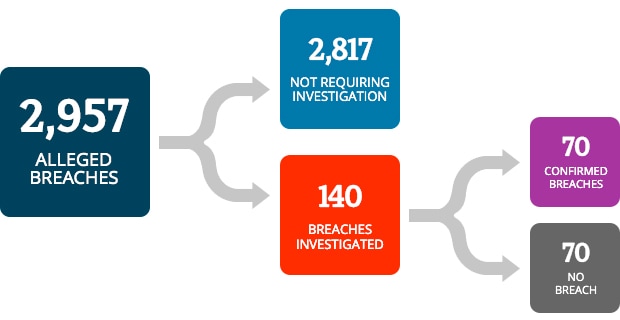
Summary of Wireless Code breaches
There were 70 confirmed breaches of the Wireless Code. This is an increase of 52%, from 46 confirmed breaches last year.
- Clarity (Section A) and Contracts and related documents (Section B): These sections of the Wireless Code were the most breached requirements, with 22 confirmed breaches each. They each accounted for 31% of all confirmed wireless breaches with a significant year-over-year increase.
- Clarity (Section A): Section A breaches increased from 3 to 22 this year. Of the breaches:
- 11 were about the provider’s failure to communicate with customers clearly, accurately, or in a timely way
- 9 were related to charges for services purchased on an unlimited basis
- 2 were about the provider’s failure to ensure that the prices set out in the contract were clear and to indicate whether these prices include taxes
- Contracts and related documents (Section B): Of the 22 Section B breaches:
- 15 were about the provider’s failure to provide a permanent copy of the contract and related documents for the customer
- 4 were about the provider’s failure to provide information about other aspects of the contract
- 3 were about failure to include all key contract terms and conditions
- Bill management (Section E): Section E breaches accounted for 14% of all confirmed Wireless Code breaches. Most of these breaches (7 out of 10) were about the provider’s failure to suspend data roaming charges once the cap threshold was reached.
- Disconnection (Section I): There were 9 confirmed breaches to Section I. This is down from 24 confirmed breaches last year. Disconnection breaches accounted for 13% of all confirmed Wireless Code breaches.
Note: In charts throughout this report, year-over-year increases are shown in red, and year-over-year decreases are shown in green.
Wireless Code confirmed breaches by service provider
TELUS had the greatest number of confirmed Wireless Code breaches and the largest increase in breaches, from 12 to 25. TELUS accounted for 36% of all confirmed breaches. The increase is mainly driven by the increase in breaches of Section B (Contracts and related documents).
Bell’s confirmed Wireless Code breaches increased from 10 to 19. Freedom Mobile also saw an increase in confirmed breaches, from 1 to 9. Both providers saw an increase in breaches of Section A (Clarity) for failure to communicate with customers clearly, in a timely way, accurately, and using plain language.
Rogers/Shaw had 6 confirmed breaches of the Wireless Code, up from 4 last year.
Internet Code
The Internet Code was created so fixed internet access service customers are better informed of their rights and responsibilities, as detailed in their contracts with internet service providers (ISPs). The Internet Code aims to make it easier for individual customers to:
- understand their internet service contracts
- know when they will be charged fees and when prices will increase
- switch internet service providers
The Internet Code applies only to individual customers; it does not apply to small business customers.
The Internet Code applies to large facilities-based ISPs and their brands and affiliates, which are listed in Table 8.3. However, when we investigate a complaint about an ISP to which the Internet Code does not apply, we may use the principles of the Code to guide us in determining what is good industry practice.
Summary of Internet Code breaches
There were 27 confirmed breaches of the Internet Code this year, up from 12 last year. The top confirmed breach areas were:
- Section G (Contract cancellation and extension): 10 confirmed breaches, up from 0 last year (37% of confirmed Internet Code breaches)
- Section F (Equipment issues): 6 confirmed breaches, up from 3 last year (22% of confirmed Internet Code breaches)
- Section D (Changes to contracts and related documents): 4 confirmed breaches, same as last year (22% of all confirmed Internet Code breaches)
- Section I (Disconnection): 3 confirmed breaches, up from 1 last year
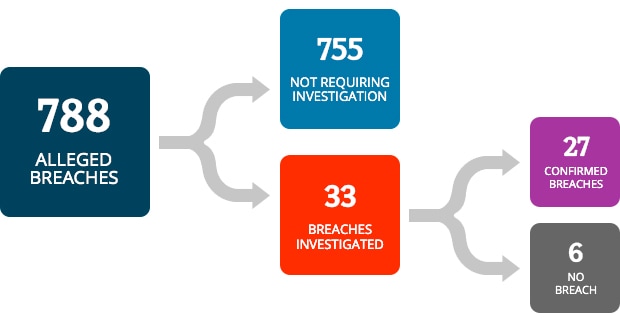
| Large facilities-based Internet service providers | Related Internet brands and affiliates |
|---|---|
| Bell Canada |
|
| Cogeco Connexion Inc. |
|
| Eastlink |
|
| Rogers/Shaw |
|
| Sasktel | |
| TELUS |
|
| Videotron Ltd. |
|
| Xplore |
|
* Northwestel has two kinds of internet services: terrestrial (on land) and satellite. Northwestel’s terrestrial retail internet services are regulated by the CRTC, therefore out of the CCTS’ mandate and customers should forward their complaint to the CRTC. Northwestel’s satellite retail internet is not regulated by the CRTC, so the CCTS can accept complaints about these services.
Internet Code confirmed breaches by service provider
Rogers/Shaw accounted for 52% of all confirmed Internet Code breaches with 14 breaches, up from 1 last year. These breaches concern:
- contract cancellation and extension problems (Section G)
- equipment issues (Section F)
TELUS had 5 confirmed Internet Code breaches, up from 1 last year. Its breaches are related to its failure to provide required information about:
- changes to contracts and related documents (Section D)
- contracts and related documents (Section B)
This year, Altima was confirmed to have breached the Internet Code for the first time, with 3 breaches about:
- its failure to clearly communicate with a customer (Section A, Clarity)
- its failure to provide required information in contracts and related documents (Section B)
- Critical Information Summary (Section C)
Television Service Provider Code
The Television Service Provider Code (TVSP Code) aims to make it easier for consumers to:
- understand their television service agreements
- be empowered in their relationships with TVSPs
The TVSP Code applies to individual customers. It does not apply to small business TV customers. All licensed TV service providers must meet the Code’s requirements. We address complaints about subscription TV services provided by cable, Internet Protocol television (IPTV), and national satellite direct-to-home (DTH) providers.
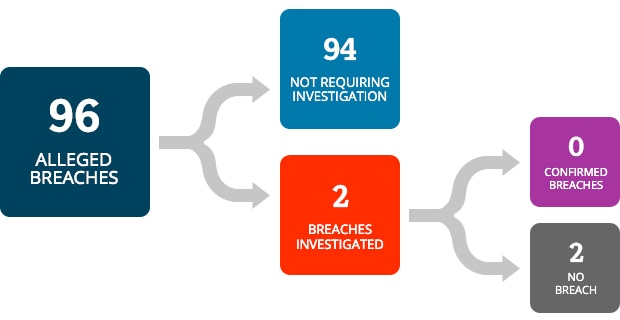
TVSP Code confirmed breaches
There were no confirmed breaches of the TVSP Code this year, down from 4 breaches last year and 14 the year before.
Deposit and Disconnection Code
The Deposit and Disconnection Code (D&D Code) protects local phone customers when:
- they are required to provide a deposit to obtain local phone service
- a service provider intends to disconnect the customer’s local phone service
There were 8 confirmed breaches to the D&D Code this year, up from 5 breaches last year. Five of the 8 breaches were related to improper disconnection or no grounds for disconnection (Section 3.1).
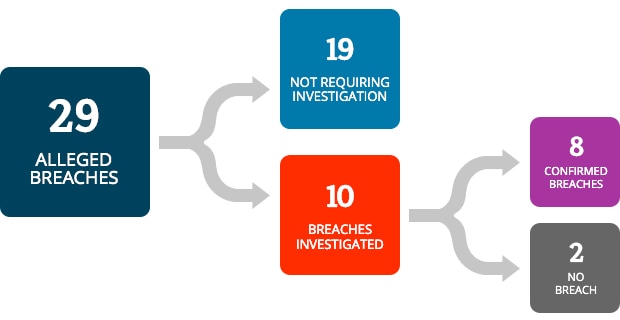
Deposit and Disconnection Code confirmed breaches by service provider
Free Phone Line accounted for half of the confirmed breaches to the Deposit and Disconnection Code this year, with 4 confirmed breaches, up from 0 breaches last year. These breaches all relate to Free Phone Line’s failure to ensure it had proper grounds for disconnection.