Other statistical highlights

Annual Report
August 1, 2024 – July 31, 2025
Contact Centre activities
Our Contact Centre received more than 124,000 communications by telephone, in writing, and by online chat in 2024–25. This is a marginal increase of 0.2% from last year.
| Type of communication | 2024-25 | Year-over-year change |
|---|---|---|
| Written correspondence* | 67,235 | +16% |
| Phone calls answered | 54,075 | -14% |
| Chat sessions answered | 2,922 | +2% |
| Total communications | 124,232 | +0.2% |
* Written correspondence refers to communication received via email, postal mail, and the CCTS online complaint form.
Written correspondence increased for the second year in a row. This year we saw a 16% increase after an increase of 76% last year. For the first time, it became the most-used type of communication, replacing phone calls.
Out-of-mandate issues
Each year, some customer complaints raise issues that we are unable to accept because they fall outside our mandate. The Canadian Radio-television and Telecommunications Commission (CRTC) set our mandate and reviews it from time to time.
The scope of complaints that the CCTS is authorized to receive, along with examples of services and subjects that fall outside the scope of the CCTS, are set out in our Procedural Code. When we receive complaints that are outside our mandate, such as pricing, infrastructure, or privacy issues, we notify the customer and the provider. We then refer the customer to a more appropriate organization or complaint-handling body.
The tables below show the number of issues raised by customers that we could not accept because they were outside our mandate.
Procedural Code Section 3
Out-of-mandate issues have declined for six consecutive years, with a 30% decrease this year despite an increase in accepted complaints and issues. This steady downward trend may be due to the positive impact of ongoing improvements, such as complaint handling process and online customer complaint form enhancements.
| Issue | Number |
|---|---|
| Out-of-mandate telecom issues | |
| Internet applications and content, s. 3.1(a)(i) | 44 |
| Infrastructure s. 3.1(c)(vi) rights of way s. 3.1(c)(vii) plant, poles, towers s. 3.1(c)(iv) networking services |
602 |
| Customer equipment and wiring s. 3.1(c)(i) customer-owned equipment s. 3.1(c)(ii) inside wiring |
259 |
| Regulated services s. 3.1(a)(ii) emergency services s. 3.1(a)(iii) payphones s. 3.1.(a)(vi) 900/976 calls |
26 |
| Telemarketing and unsolicited spam, s. 3.1.(a)(v) | 180 |
| Phone or internet scams | 95 |
| Other s. 3.1(a)(iv) Yellow Pages or business directories |
38 |
| Out-of-mandate broadcasting issues | |
| Content s. 3.1(b)(i) digital media broadcasting undertaking services s. 3.1(b)(ii) interactive TVSP services and applications s. 3.1(b)(iii) broadcasting content s. 3.1(b)(iv) journalistic ethics s. 3.1(b)(vi) simultaneous substitution |
62 |
| TVSP not required to participate in CCTS | 10 |
| Other | 20 |
| Other out-of-mandate issues | |
| False/misleading advertising, s. 3.1(c)(viii) | 374 |
| Aggressive tactics | 239 |
| Privacy issues, s. 3.1(c)(ix) | 420 |
| Pricing, s. 3.1(c)(v) | 590 |
| Security services, s. 3.1(c)(iii) | 305 |
| Total for all out-of-mandate issues* | 3,264 |
* Some out-of-mandate issues are raised in complaints that also raise in-scope issues.
Procedural Code Section 4
Complaints about customer service, operating practices, or service provider policies do not fall within our mandate. However, we track the inquiries we get about these issues.
This year, we saw the fourth year in a row of decreases. There were 4,337 issues, representing a 15% decrease year-over-year.
| Issue | Number | |
|---|---|---|
| Section 4.1 Customer service | ||
| Rude representative | 327 | |
| Wait times | 472 | |
| Other – Customer services | 1,161 | |
| Total | 1,960 | |
| Section 4.3 General operating practices and policies | 2,377 | |
| Total issues | 4,337 | |
Procedural Code Section 10
Under our Procedural Code, we have a duty to decline complaints when:
- The customer has not yet given the service provider a reasonable opportunity to resolve the issues (Section 10.1).
- The same complaint had been or was being dealt with by another agency with authority to compensate the customer for loss (Section 10.2(b)).
- The facts of the complaint relate to events that happened more than a year before the complaint was submitted (Section 10.3(a)).
- The complaint is about issues that happened more than one year before the service provider joined the CCTS as a Participating Service Provider on or after September 1, 2017 (Section 10.3(b)).
While we must decline such complaints, we track and report on them.
In the past year, issues that fell under our duty to decline to take action increased by 35%, following a decrease of 83% last year. At the end of the fiscal year (July 2025), we added guidance to our complaint form to help customers understand that they must work with their service provider before submitting a complaint to the CCTS.
| Issue | Number |
|---|---|
| Section 10.1 PSP not offered the opportunity to resolve | 226 |
| Section 10.2(b) matter previously or currently with another agency | 33 |
| Section 10.3(a) facts transpired over one year ago | 437 |
| Section 10.3(b) facts arose one year prior to PSP joining the CCTS | 2 |
| Total issues | 698 |
Out-of-mandate accessibility issues
Most issues about a service provider’s failure to accommodate a customer’s accessibility requests are outside of our mandate.
At the request of the CRTC and members of the accessibility community, we track when customers raise out-of-mandate accessibility issues about their service providers. We also refer these issues to the CRTC, which may have the authority to address them.
| Issue | Number |
|---|---|
| Customer Service – indifferent to customer’s disability | 141 |
| Accessibility-related accommodation issue (e.g. video relay services (VRS), message relay services (MRS), closed captioning, or described video not available; accessible handset not offered; store accessibility issues; refused to provide accessibility plan) | 79 |
| Policies and procedures (e.g. do not include accessibility information, or accessibility policy or practice not honoured) | 104 |
| Total out-of-mandate issues | 324 |
The CRTC codes that we administer contain some accessibility-related requirements. These are within our mandate. The Wireless Code, Television Service Provider Code, and Internet Code require two kinds of accommodations:
- an extended trial period for individuals with disabilities
- contracts and related documents provided in an accessible format upon request
For more information, see Code of Conduct Reporting.
Analysis of closed complaints
This year, we closed 2,059 complaints. Most of these were due to uncooperative customers (59%), withdrawn complaints (19%), and duplicate complaints (15%). The following table breaks down the reasons for closing complaints and refers to the relevant sections of the Procedural Code.
| Complaint | Issues | % of all closed complaints |
|---|---|---|
| Closed as duplicate | 315 | 15.3% |
| Customer withdrew complaint | 395 | 19.2% |
| Out-of-mandate after further information obtained | 22 | 1.1% |
| Section 9.1(b) Customer is not authorized to file complaint | 11 | 0.5% |
| Section 9.1(c) Complaint more appropriately handled by another agency | 50 | 2.4% |
| Section 9.1(d) Further investigation not warranted | 0 | 0.0% |
| Section 9.1(e) Customer not cooperative | 1,215 | 59.0% |
| Section 10.1 Service provider not offered opportunity to resolve | 5 | 0.2% |
| Section 10.2(b) Matter previously or currently with another agency | 5 | 0.2% |
| Section 10.3(a) Complaint filed outside time limits | 41 | 2.0% |
| Section 10.3(b) Facts arose one year prior to PSP joining the CCTS | 0 | 0.0% |
| Total complaints | 2,059 | 100% |
We close complaints under section 9.1(e) of our Procedural Code when a customer does not cooperate with our efforts to process and investigate their complaints. For example, we may close a complaint if the customer does not provide information about their complaint, does not respond to our inquiries, or refuses to engage with their provider during the 20-day Initial Referral stage. We make multiple attempts to elicit customer cooperation before closing a complaint.
Small business customer complaints
Our mandate provides recourse for small business customers whose monthly bill for all telecommunications services is normally under $2,500.
For the second year in a row, we saw an increase in complaints from small business customers. In 2024–25, we concluded 2,136 complaints submitted by small business customers, an increase of 60% from the previous year. This represents 10% of all concluded complaints this year.
The were 4,326 issues reported within those 2,136 complaints. This is a 52% increase in issues from last year. Small business customer issues make up 10% of all issues, up from 7% last year.
When we report our operational statistics, we include the data for all the complaints we dealt with during the year. However, not all complaints are the same. Complaints from small business customers are often very different from those of individual consumers. The following tables highlight the differences.
| Issue category | Small business customers | Individual customers |
|---|---|---|
| Billing | 43.3% | 46.6% |
| Contract dispute | 31.6% | 24.3% |
| Service delivery | 21.5% | 25.0% |
| Credit management | 3.4% | 3.9% |
| In-mandate accessibility issues | 0.1% | 0.2% |
| Service type | Small business customers | Individual customers |
|---|---|---|
| Wireless | 59.7% | 49.7% |
| Internet | 23.6% | 27.8% |
| Local phone | 16.3% | 6.6% |
| Long distance | 0.3% | 0.2% |
- Wireless issues remain the most raised by small business customers and are raised more frequently when compared to individual customers: 60% of issues raised by small business customers are about wireless services, up from 42% last year.
- The proportion of small business internet issues decreased for the second year in a row and now accounts for 24% of small business issues, down from 33% last year.
- Billing issues remain the most-raised issue, accounting for 43% of issues raised by small business customers, up from 38% last year.
| Issue | Small business customers | Individual customers |
|---|---|---|
| Incorrect charge for monthly price plan | 15.3% | 13.7% |
| Disclosure issues | 12.7% | 9.6% |
| Credit or refund not received | 8.8% | 9.2% |
| Breach of contract | 6.5% | 5.3% |
| Regular price increase of monthly price plans | 6.3% | 6.8% |
| Termination fee | 6.1% | 3.1% |
| Quality of service | 5.8% | 8.4% |
| Changes to the contract | 4.2% | 5.5% |
| Complete loss of service | 3.2% | 3.9% |
| Third-party credit reporting | 3.2% | 3.7% |
Compensation analysis
When complaints are resolved through the CCTS process, customers may receive compensation from their service provider. This compensation can take many forms, including:
- bill credits
- bill adjustments
- free or discounted products and services
- cash payments
At the Conciliation and Investigation stages, the CCTS may issue Investigation Findings that require providers to remedy the situation, including compensating the customer. At the Initial Referral stage, details of resolutions are often not shared with us, although some form of compensation might be part of the resolution reached directly between the customer and provider.
Based on the limited information available to us, total compensation awarded to customers through our process in 2024–25 was $4,243,774.
| Compensation range | Number of complaints | Percentage of compensation complaints |
|---|---|---|
| less than $100 | 4,259 | 32.8% |
| $100 – $499 | 6,708 | 51.7% |
| $500 – $999 | 1,251 | 9.6% |
| $1,000 – $4,999 | 704 | 5.4% |
| $5,000 or more | 43 | 0.3% |
| Total | 12,965 | 100% |
Performance standards
Each year, we set a goal to provide great customer service, and we track our performance across various benchmarks. The following tables show how our performance this year compares to those benchmark targets.
We are pleased to have exceeded our performance targets for the contact centre and most complaint-handling standards this past year, despite a significantly increased volume of accepted complaints last year and a continued, though smaller, increase this year. We accepted over 95% of complaints within three business days, and we concluded 85% of complaints within 60 days.
This year, we enhanced the efficiency of our Conciliation stage, resulting in major improvements. We concluded 76% of complaints at this stage within 60 days from the time they were referred to Conciliation. We continue our efforts to improve the efficiency of the Investigation stage of our process. Only about 5% of complaints are concluded at Investigation.
Contact Centre
| Process | 2024‑25 | Target |
|---|---|---|
| Answer phone calls within 120 seconds | 84.6% | 80% |
| Process written communications within five business days | 98.5% | 80% |
Complaint handling
| Process | 2024‑25 | Target |
|---|---|---|
| Assess complaints to determine if they meet eligibility criteria within three business days | 95.3% | 80% |
| Complaints concluded across all stages within 60 days | 85.4% | 80% |
| Complaints concluded at Initial Referral stage within 30 days of acceptance | 89.9% | 80% |
| Proportion of complaints concluded at Initial Referral stage – 78.5% | ||
| Complaints concluded at Conciliation stage within 60 days of referral to Conciliation | 76.2% | 80% |
| Proportion of complaints concluded at Conciliation stage – 16.4% | ||
| Complaints concluded at Investigation stage within 90 days of referral to Investigation | 42.2% | 80% |
| Proportion of complaints concluded at Investigation stage – 5.0% | ||
Regional analysis
We receive complaints from customers across Canada. Here, we identify the number of accepted complaints by province and territory.
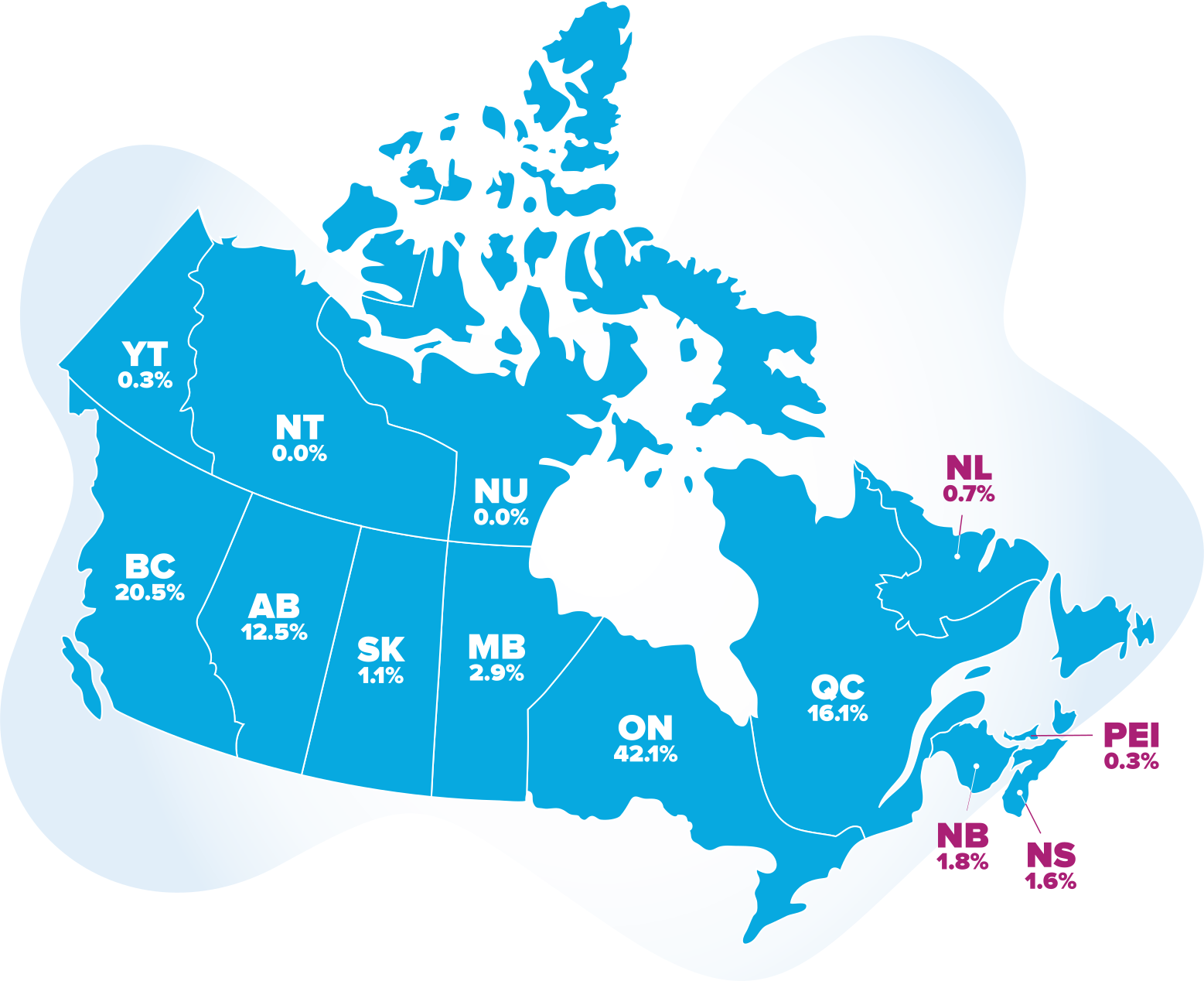
* Population estimates, quarterly (statcan.gc.ca)
| Province | Complaints | Population* | |||
|---|---|---|---|---|---|
| Alberta | 2,957 | 12.5% | 4,980,659 | 12.0% | |
| British Columbia | 4,858 | 20.5% | 5,719,961 | 13.8% | |
| Manitoba | 685 | 2.9% | 1,507,330 | 3.6% | |
| New Brunswick | 424 | 1.8% | 859,839 | 2.1% | |
| Newfoundland and Labrador | 173 | 0.7% | 545,464 | 1.3% | |
| Northwest Territories | 7 | 0.0% | 45,242 | 0.1% | |
| Nova Scotia | 387 | 1.6% | 1,080,418 | 2.6% | |
| Nunavut | 5 | 0.0% | 41,572 | 0.1% | |
| Ontario | 9,964 | 42.1% | 16,176,977 | 38.9% | |
| Prince Edward Island | 61 | 0.3% | 180,029 | 0.4% | |
| Quebec | 3,807 | 16.1% | 9,110,616 | 21.9% | |
| Saskatchewan | 259 | 1.1% | 1,253,569 | 3.0% | |
| Yukon | 60 | 0.3% | 47,111 | 0.1% | |
| Total | 23,647 | 100% | 41,548,787 | 100% | |
* Canada, Statistics Canada, Table 17-10-0009-01 (formerly, CANSIM 051-0005)