The CCTS’ role is to help customers and Participating Service Providers (PSPs) resolve disputes.
When customers and PSPs are unable to resolve their disputes, the CCTS investigates to determine how they should be concluded. The CCTS works to identify the key drivers of customer complaints so that PSPs can better understand and consider internal change to address their customers’ issues, and so that customers can be informed of trends in complaints.
In this section, we present the results for those PSPs that have been the subject of the greatest number of complaints and also discuss our Compliance Monitoring and Enforcement Program.
National PSP groups complaint proportion analysis across last four years
In this section, we look at the proportion of customer complaints about national PSP groups, which are the largest telecom and TV service providers which offer wireless service nationally to consumers and which offer internet, phone and TV services to large regions of Canada. These providers offer services to consumers through a number of affiliate brands:
Bell group: Bell Canada, Bell Aliant, Bell Mobility, Bell MTS, Bell Satellite TV, DMTS, KMTS, Lucky Mobile, PC Mobile (Prepaid), Solo, Virgin Plus and Vox;
Rogers group: Rogers Communications, Chatr Wireless, Cityfone, Compton Communications, Fido, Kincardine Group, Simply Connect and Source Cable Ltd. ; and
TELUS group: TELUS Communications Inc., Koodo, Mascon Communications Inc, PC Mobile (Post-Paid), Public Mobile, TELUS Satellite and Mascon Cable.
Figure 8.1: Accepted complaints trend over three national PSP groups
Figure 8.2: Proportion of accepted complaints for the three national PSP groups
Since 2018-19, the number of accepted complaints about the Bell group decreased from 7,646 to 3,546 this year, down by 54% compared to a 25% overall decrease in complaints.
While the Bell and Rogers groups showed a downward trend in the number of complaints this year, the TELUS group saw a slight increase from 2,082 to 2,187 complaints, up by 5%.
The three national PSP groups accounted for 72% of all accepted complaints this year.
This year the Bell group accounted for 28% of all accepted complaints across all service providers, down year-over-year since 2018-19, when it accounted for 40%.
The Rogers group had the largest increase in the proportion of complaints over the last four years across the national PSP groups, from 15% of all complaints in 2018-19 to 27% of all complaints in 2021-22. The increase in the Rogers group proportion of complaints is largely due to an increase in complaints about Rogers Communications and Fido.
This year the TELUS group accounted for 17% of all accepted complaints across all service providers, up from 12% last year.
Top 25 Participating Service Providers
Table 8.1: Top 25 PSPs by complaints accepted
wdt_ID
Service provider
Accepted complaints
Percentage of all complaints
YoY % change of complaints accepted
Concluded complaints*
Resolution rate†
Escalation rate††
1
Bell
2,198
17.2%
-37.5
2,267
83.5%
30.8%
2
Rogers
2,014
15.7%
-14.7
1,896
87.4%
28.7%
3
Fido
1,328
10.4%
-20.8
1,298
89.4%
30.4%
4
TELUS
1,256
9.8%
2.9
1,171
89.7%
17.8%
5
Virgin Plus
941
7.4%
-19.4
947
86.0%
31.6%
6
Koodo
828
6.5%
10.5
794
89.8%
14.0%
7
Freedom Mobile
753
5.9%
-24.3
746
92.8%
21.8%
8
Videotron
610
4.8%
-43.2
664
93.7%
16.1%
9
Shaw
558
4.4%
-35.9
583
89.2%
14.2%
10
Xplornet
187
1.5%
-62.6
212
78.3%
21.7%
* The number of concluded complaints can be higher than the number of accepted complaints because some complaints received in 2020-21 were also concluded in 2021-22.
† The resolution rate is the percentage of all resolved complaints vs. all concluded complaints (87.7% overall).
‡ The escalation rate is the percentage of all escalated complaints vs. all concluded complaints (25.2% overall).
NOTE: Where a complaint remains unresolved after the pre-investigation or initial referral period, the complaint escalates to a CCTS investigation.
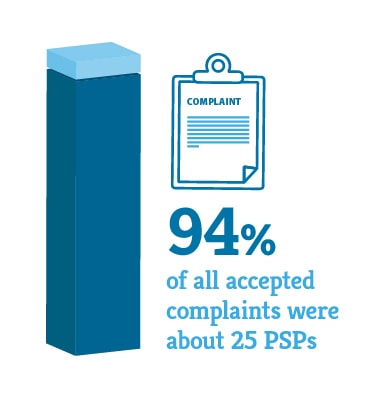
Together, the top 25 PSPs account for 94% of all accepted complaints in 2021-22. One hundred and seventy-one (171) PSPs account for the remaining 6% of accepted complaints this year. The Top 10 PSPs are discussed in more detail later in the Top 10 PSP profiles section.
There are a few changes to the list of service providers that fall into the Top 25 PSPs list this year.
Of the providers in the preceding table, TELUS, Koodo, Fizz, Bell MTS, Primus, Eastlink and PC Mobile experienced increases in the number of complaints since last year, which is noteworthy considering the year-over-year decline of 25% for overall complaints.
PC Mobile, a prepaid service, entered the Top 25 PSP list this year, with a 138% increase in complaints. It received 38 complaints this year compared to 16 last year. The increase appears to be due to disclosure and billing issues.
All other providers had a decrease in complaints. Xplornet and Comwave had the most significant decreases in complaints, declining by 63% and 76% respectively.
Top 10 Participating Service Providers profiles
In this section, we identify areas of good performance as well as areas of improvement for the top 10 PSPs.
Figure 8.3: Top 10 PSPs by complaints accepted
Figure 8.4: Top 10 PSPs by resolution rate
NOTE: The global average resolution rate was 87.7%
Bell
WirelessInternetPhoneTV
Insights
Bell complaints decreased for the third year in a row. This year Bell’s complaints decreased by 38%, which is a notable decrease compared to the 25% decrease in complaints across all providers.
Bell accounts for 17% of all accepted complaints, down from 21% last year.
Wireless issues decreased by 37%, a significant decrease considering a 19% decrease in wireless issues across all providers. Wireless issues account for 43% of Bell’s issues, which is lower than the overall proportion of wireless issues across all providers (51%).
Internet issues account for 27% of Bell’s issues, the same as last year.
TV issues continue to account for 14% of all Bell issues, the same as last year.
Bell’s most complained-about issue is incorrect charge relating to monthly price plan. It accounts for 14% of Bell’s issues even though its customers raised this issue 39% fewer times compared to last year.
Notably, Bell customers raised roaming charge issues more often this year, up by 165%. Roaming issues increased for all service providers by 130%.
Bell had 6 confirmed breaches of the Wireless Code, a significant decrease from 29 confirmed breaches last year. This accounts for 9% of all confirmed Wireless Code breaches, down from 30% last year. Of the six confirmed breaches, three were related to disconnection issues.
Bell had 2 confirmed breaches of the Internet Code, down from 14 last year and accounting for 9% of all confirmed Internet Code breaches.
Bell is the only service provider with confirmed breaches of the Deposit and Disconnection Code, with two counts.
Statistics
2,198 accepted complaints
-37.5% change in accepted complaints
17.2% of all accepted complaints
1,893 resolved complaints
1,356 resolved at pre-investigation
537 resolved at investigation
83.5% resolution rate (global – 87.7%)
Top 3 issues across all service types
14% incorrect charge relating to monthly price plan
13% disclosure issues
10% quality of service
11 Code breaches
6 Wireless Code breaches
2 Internet Code breaches
1 TVSP Code breach
2 D&D Code breaches
Rogers
WirelessInternetPhoneTV
Insights
Rogers’ complaints decreased by 15% compared to a 25% decrease in complaints across all providers. Rogers accounts for 16% of all accepted complaints, up over three years from 11% to 16%.
Wireless issues account for 44% of all Rogers’ issues, up from 40% last year.
Internet issues account for 32% of all Rogers’ issues, which is higher than the proportion of internet issues overall (27%). Rogers’ customers raised internet issues 26% less often than last year compared to a 40% decrease in internet issues across all providers.
Rogers’ TV issues account for 16% of all Rogers’ issues, down from 18% last year. This is higher than the proportion of TV issues overall (11%).
Rogers’ most complained-about issue is incorrect charge for monthly price plans. This issue accounts for 14% of all of Rogers’ issues even though its customers raised this issue 39% fewer times compared to last year.
Rogers’ customers raised the following issues more often than last year:
Device or equipment financing plan issues, up by 144% from last year;
Roaming charge issues, up by 133%;
Complete loss of service, up by 16% compared to a decrease of 20% for all service providers; and
Legitimacy of the early termination fee, up by 27%.
Rogers had 7 confirmed breaches of the Wireless Code, a significant drop from 25 last year. This accounts for 11% of all confirmed Wireless Code breaches, down from 26% last year. Of the seven breaches, six were about disconnection issues. Disconnection issues were also the subject of its two confirmed Internet Code breaches.
Statistics
2,014 accepted complaints
-14.7% change in accepted complaints
15.7% of all accepted complaints
1,657 resolved complaints
1,236 resolved at pre-investigation
421 resolved at investigation
87.4% resolution rate (Global – 87.7%)
Top 3 issues across all service types
14% incorrect charge relating to monthly price plan
14% disclosure issues
12% quality of service
9 Code breaches
7 Wireless Code breaches
2 Internet Code breaches
0 TVSP Code breaches
0 D&D Code breaches
Fido (owned by Rogers)
WirelessInternet
Insights
Fido complaints decreased by 21% compared to a 25% decrease in complaints across all providers.
Fido accounts for 10% of all accepted complaints, on par with last year.
Fido’s wireless issues decreased by 4% this year. However, wireless issues account for 93% of Fido’s issues compared to 79% last year.
Internet issues decreased by 69% this year, now accounting for 8% of all of Fido’s issues. The decrease seems to have been driven by a significant decline in the number of breach of contract issues and credit/refund not received issues for internet services.
Device/equipment financing plan is the most-increased issue raised by Fido customers, up by 200%.
Issues about long-distance charges (chargeable messages) have increased significantly (1,215%) over five years. This year, Fido’s chargeable messages issues are up by 46%.
Customers also raised activation/reactivation charge issues with Fido more every year over the past five years, with an increase of 750% over five years.
Incorrect charge issues account for 13% of Fido’s issues even though there was a 24% decrease in this issue.
Fido’s confirmed breaches of the Wireless Code continued to drop, with 5 confirmed breaches this year compared to 9 last year and 13 the year before. Two of the five breaches were about Fido not providing a paper or electronic copy of the contract to the customer or that the contract did not include all the information required in the Wireless Code.
Statistics
1,328 accepted complaints
-20.8% change in accepted complaints
10.4% of all accepted complaints
1,161 resolved complaints
847 resolved at pre-investigation
314 resolved at investigation
89.4% resolution rate (Global – 87.7%)
Top 3 issues across all service types
18% disclosure issues
13% incorrect charge relating to monthly price plan
7% chargeable messages (long distance)
5 Code breaches
5 Wireless Code breaches
0 Internet Code breaches
0 D&D Code breaches
TELUS
WirelessInternetPhoneTV
Insights
TELUS complaints increased by 3% compared to a 25% decrease in complaints across all providers.
TELUS accounts for 10% of all accepted complaints, up from 7% last year.
Wireless issues account for 53% of all TELUS issues. The number of TELUS’ wireless issues increased by 4% this year compared to a 19% decrease in wireless issues across all service providers.
Internet issues account for 25% of all TELUS issues. The number of TELUS’ internet issues declined by 16% compared to the 40% decrease in internet issues across all providers. This is the first time TELUS’ internet issues decreased in five years.
TV issues account for 11% of all TELUS issues, down 2% from last year.
TELUS’ long distance issues increased by 36% compared to a 61% decrease across all providers.
Incorrect charge issues became the most complained-about issue for TELUS customers, accounting for 14% of all issues. This issue increased by 2% this year for TELUS, which is notable considering that the issue declined by 31% across all service providers.
Disclosure issues are the number two issue for TELUS customers, up by 4% from last year and accounting for 13% of all TELUS issues. Meanwhile, disclosure issues decreased by 36% for all service providers.
Quality of service issues dropped to the number three issue for TELUS customers, down by 34% from last year and accounting for 10% of all TELUS issues. This is the first time TELUS saw this issue decrease in three years.
TELUS’ confirmed Code breaches increased significantly from 8 last year to 22 this year.
TELUS accounts for half of all confirmed Internet Code breaches with 11 breaches, up from zero last year. Six of these confirmed breaches were for failing to provide required information in contracts and related documents and the remaining five were for lack of clarity in its communications with customers.
TELUS had eight confirmed Wireless Code breaches, unchanged from last year. Two of these confirmed breaches were related to disconnection issues.
TELUS had three confirmed breaches of the TVSP Code compared to zero last year, accounting for 33% of all confirmed TVSP Code breaches. The three confirmed breaches are related to its failure to give the customer a copy of the written contract or the Critical Information Summary or to provide clear information of the offer.
Statistics
1,256 accepted complaints
2.9% change in accepted complaints
9.8% of all accepted complaints
1,050 resolved complaints
907 resolved at pre-investigation
143 resolved at investigation
89.7% resolution rate (Global – 87.7%)
Top 3 issues across all service types
14% incorrect charge relating to monthly price plan
13% disclosure issues
10% quality of service
22 Code breaches
8 Wireless Code breaches
11 Internet Code breaches
3 TVSP Code breaches
0 D&D Code breaches
Virgin Plus (owned by Bell)
WirelessInternetPhone
Insights
Virgin Plus (formerly Virgin Mobile Canada) complaints decreased by 19% compared to a 25% decrease in complaints across all providers. Virgin Plus accounts for 7% of all accepted complaints, unchanged from last year.
Internet issues increased by 11% despite overall internet issues decreasing by 40%. Internet issues account for 15% of all issues for Virgin Plus. The number of internet issues raised by Virgin Plus customers has grown year-over-year for five years.
Disclosure is still the most complained-about issue for Virgin Plus, accounting for 14% of all its issues, down from 17% last year.
Device financing plan issues continue to increase for Virgin Plus, with a 100% increase in these issues.
Credit reporting issues account for 5% of all issues raised by Virgin Plus customers. The number of these issues increased by 5% this year while credit reporting issues decreased by 19% across all service providers.
Virgin Plus had 11 confirmed breaches of the Wireless Code, up from 6 last year and 4 the year before. Virgin Plus accounted for 17% of all confirmed Wireless Code breaches. Three of 11 breaches were about disconnection issues. Two others related to lack of clarity; two related to not providing required information in the Critical Information Summary; and two related to not giving the customer a copy of the written contract.
Virgin Plus also had two confirmed Internet Code breaches, both related to disconnection issues.
Statistics
941 accepted complaints
-19.4% change in accepted complaints
7.4% of all accepted complaints
814 resolved complaints
575 resolved at pre-investigation
239 resolved at investigation
86.0% resolution rate (Global – 87.7%)
Top 3 issues across all service types
14% disclosure issues
12% incorrect charge relating to monthly price plan
7% credit/refund not received
13 Code breaches
11 Wireless Code breaches
2 Internet Code breaches
0 D&D Code breaches
Koodo (owned by TELUS)
Wireless
Insights
Koodo complaints increased by 11% compared to a 25% decrease in complaints across all providers. Koodo accounts for 7% of all accepted complaints, up from 4% last year.
The top three Koodo issues are incorrect charge (13% of Koodo’s issues), disclosure issues (11%) and credit reporting (9%). Notably, Koodo’s credit reporting issues increased by 12% this year compared to a 19% decrease in credit reporting issues across all service providers.
As the biggest issue for Koodo, incorrect charge has been increasing year-over-year for the past five years.
Quality of service issues account for 6% of all Koodo’s issues and have increased year-over-year during the last five years.
There are significant increases in device financing plan issues and roaming charge issues.
Koodo had eight confirmed Wireless Code breaches this year, doubled from four last year. Four of the eight confirmed breaches were related to Koodo’s failure to provide required information in the Critical Information Summary and the remaining four breaches related to not providing a paper or electronic copy of the contract to the customer.
Statistics
828 accepted complaints
10.5% change in accepted complaints
6.5% of all accepted complaints
713 resolved complaints
638 resolved at pre-investigation
75 resolved at investigation
89.8% resolution rate (Global – 87.7%)
Top 3 issues across all service types
13% incorrect charge relating to monthly price plan
11% disclosure issues
9% credit reporting
8 Code breaches
8 Wireless Code breaches
0 D&D Code breaches
Freedom Mobile (owned by Shaw)
Wireless
Insights
Freedom Mobile complaints decreased for the third year in a row. Freedom Mobile complaints decreased by 24%. Freedom Mobile accounts for 6% of all accepted complaints, unchanged from last year.
The vast majority of Freedom Mobile’s issues are about wireless services (98%). Freedom Mobile began offering internet services in 2019 and received only 28 issues about its internet services this year.
The most-complained about issue for Freedom Mobile customers relates to disclosure, accounting for 15% of all Freedom Mobile issues despite a decrease of 24% from last year. Quality of service is the number two issue, accounting for 12% of all Freedom Mobile’s issues even though it decreased by 28%.
Credit management issues were raised by Freedom Mobile customers 48% less often than last year compared to the 20% decrease in overall credit management issues.
Freedom Mobile had 12 confirmed breaches of the Wireless Code, up from 5 last year and accounting for 19% of all confirmed breaches of the Wireless Code. Four of 12 breaches were related to Freedom Mobile’s failure to provide a paper or electronic copy of the contract to the customer or with providing inaccurate information. Another four breaches related to not providing information required in the Critical Information Summary. The remaining four breaches were about disconnection issues.
Statistics
753 accepted complaints
-24.3% change in accepted complaints
5.9% of all accepted complaints
692 resolved complaints
565 resolved at pre-investigation
127 resolved at investigation
92.8% resolution rate (Global – 87.7%)
Top 3 issues across all service types
15% disclosure issues
12% quality of service
11% incorrect charge relating to monthly price plan
12 Code breaches
12 Wireless Code breaches
Videotron
WirelessInternetPhoneTV
Insights
Videotron complaints decreased by 43% compared to a 25% decrease in complaints across all providers. Videotron accounts for 5% of all accepted complaints, down from 6% last year.
Wireless issues decreased by 47% for Videotron compared to a 19% decrease in wireless issues across all service providers. Wireless issues account for 26% of all Videotron issues.
Videotron’s internet issues decreased by 41%, on par with the 40% decrease in internet issues across all service providers. Internet issues account for 34% of all Videotron issues, unchanged from last year.
TV issues decreased by 39% for Videotron compared to a 35% decrease in TV issues across all service providers. TV issues account for 27% of all Videotron issues.
Videotron customers raised device financing plan issues 92% more often this year.
The most complained-about issues raised by Videotron customers are disclosure issues and incorrect charge for monthly price plans, each accounting for 20% of Videotron’s issues.
Videotron had three confirmed breaches of the Wireless Code, down from six last year.
Videotron had three confirmed Internet Code breaches compared to zero last year. The confirmed breaches were about not providing key contract terms and conditions or the Critical Information Summary.
Videotron had four confirmed TVSP Code breaches, up from two last year and accounting for 44% of all confirmed TVSP Code breaches. Two of Videotron’s four confirmed breaches were about not providing information required in the Critical Information Summary.
Statistics
610 accepted complaints
-43.2% change in accepted complaints
4.8% of all accepted complaints
622 resolved complaints
538 resolved at pre-investigation
84 resolved at investigation
93.7% resolution rate (Global – 87.7%)
Top 3 issues across all service types
20% disclosure issues
20% incorrect charge relating to monthly price plan
6% credit/refund not received
10 Code breaches
3 Wireless Code breaches
3 Internet Code breaches
4 TVSP Code breaches
0 D&D Code breaches
Shaw
WirelessInternetPhoneTV
Insights
Shaw complaints decreased by 36% compared to a 25% decrease in complaints across all providers. Shaw accounts for 4% of all accepted complaints, down from 5% last year.
Internet issues account for 51% of all Shaw issues. The number of Shaw’s internet issues decreased by 45% compared to a 40% decrease in internet issues across all providers.
Wireless issues account for 14% of all Shaw issues, up from 6% last year. Wireless issues were raised 46% more often by Shaw customers than last year. (Shaw launched Shaw Mobile in July of 2020.)
TV issues account for 24% of all Shaw issues. Shaw’s TV issues decreased by 30% compared to a 35% decrease in TV issues across all service providers.
Shaw’s top issue is quality of service, up from 14% last year and accounting for 16% of its issues.
Shaw’s disclosure issues decreased by 46% while overall disclosure issues decreased by 36%. Disclosure issues account for 14% of all Shaw issues, the same as last year.
Shaw had five confirmed breaches of the Wireless Code this year, up from three last year.
Statistics
558 accepted complaints
-35.9% change in accepted complaints
4.4% of all accepted complaints
520 resolved complaints
464 resolved at pre-investigation
56 resolved at investigation
89.2% resolution rate (Global – 87.7%)
Top 3 issues across all service types
16% quality of service
14% disclosure issues
11% legitimacy of early termination fee
5 Code breaches
5 Wireless Code breaches
0 Internet Code breaches
0 TVSP Code breaches
0 D&D Code breaches
Xplornet*
InternetPhone
Insights
While complaints across all providers decreased by 25% overall, Xplornet complaints decreased by 63%. Xplornet accounts for 2% of all accepted complaints, down from 3% last year.
Internet issues account for 97% of Xplornet’s issues because Xplornet is primarily an internet service provider. Xplornet saw a 58% decrease in internet issues this year compared to a 40% decrease in internet issues across all service providers.
The decrease in Xplornet’s internet issues is driven mostly by a significant 61% decrease in service delivery issues. Quality of service remains the top issue for Xplornet customers, accounting for 45% of all Xplornet’s issues. The number of times Xplornet customers raised quality of service issues decreased by 68% this year.
Xplornet had two confirmed Internet Code breaches compared to zero last year. Its two confirmed breaches involved a lack of clarity of information.
* In September 2022, Xplornet rebranded to Xplore.
Statistics
187 accepted complaints
-62.6% change in accepted complaints
1.5% of all accepted complaints
166 resolved complaints
130 resolved at pre-investigation
36 resolved at investigation
78.3% resolution rate (Global – 87.7%)
Top 3 issues across all service types
45% quality of service
8% complete loss of service
6% incorrect charge relating to monthly price plan
2 Code breaches
2 Internet Code breaches
0 D&D Code breaches
Monitoring service provider compliance
There are two categories of service provider requirements: the CRTC requirement to participate in the CCTS; and the CCTS requirements that service providers agree to when it becomes a Participating Service Provider (PSP).
To ensure the CCTS can provide free and effective service to customers when they need it, the CRTC requires companies that provide retail telecom services in Canada, as well as licensed TV service providers, to participate in the CCTS. We also receive requests from some service providers who choose to participate in the CCTS voluntarily.
Some service providers (typically small providers or new entrants to the business) do not currently participate. Their obligation to join is triggered when one of their customers files a complaint with the CCTS.
We do everything in our power to get these service providers to join, and we’re generally successful. This year it took us, on average, 37 days to sign up a new provider from the time it was informed of its requirement to participate. Due to the COVID-19 pandemic, some service providers encountered financial difficulties paying the sign-up fees and faced challenges accessing information required for sign-up while working remotely.
In 2021-22, we signed up 24 new service providers. Unfortunately, some providers refuse to join the CCTS. If we’re unable to persuade them to follow the rules and become a PSP, we refer the matter to the CRTC for further action. Last year, the CRTC initiated show cause proceedings against Net2Web Inc.and 9319-4082 Québec inc. (Haute-Vitesse.com) for failing to sign up with the CCTS when required to do so.
After a provider has become a PSP, it is required to adhere to the CCTS obligations outlined in the Participation Agreement, including:
complying with the CCTS Procedural Code, which contains rules for CCTS’ complaint-handling process;
paying fees and disclosing certain financial information.
The CCTS regularly monitors PSP compliance with these obligations and engages with PSPs to bring them into compliance. If a PSP continues to be non-compliant, the CCTS has a range of enforcement tools to seek PSP compliance, up to and including the expulsion of non-compliant PSPs from the CCTS: this triggers a referral to the CRTC for further action.
In August of 2022, we issued the annual Compliance Monitoring Report, which explains the compliance requirements in detail, provides the results of the CCTS’ compliance monitoring efforts in 2021, and discusses trends observed in the last five years. The CCTS also regularly updates our Non-compliant providers web page, publishing the identities of providers who were referred to the CRTC for failure to join the CCTS when required or who are expelled from the CCTS for failing to comply with CCTS obligations.

 Together, the top 25 PSPs account for 94% of all accepted complaints in 2021-22. One hundred and seventy-one (171) PSPs account for the remaining 6% of accepted complaints this year. The Top 10 PSPs are discussed in more detail later in the